
-
Email us at:
info@weltreatsystems.com -
Call us on:
020 - 41228334 - Download Brochure

30
Jun 26Quick Answer: Chemical industry wastewater requires specialized treatment due to high COD, heavy metals, toxic organics, and variable composition. Most chemical units fall under MPCB Red Category, facing strict ETP requirements and increasing ZLD mandates in Maharashtra. Treatment typically combines chemical pre-treatment, biological oxidation, and membrane technology, with costs ranging from ₹40 lakh to several crore depending on capacity and complexity.
Chemical manufacturing generates some of the most complex industrial wastewater in India. Unlike food processing or textile effluent, chemical industry wastewater varies dramatically between batches, often contains compounds toxic to biological treatment systems, and frequently carries heavy metals that conventional ETPs cannot remove without specific engineering. For plant managers in Maharashtra’s chemical sector — concentrated heavily across Pune MIDC, Tarapur, Ankleshwar-adjacent supply chains, and Raigad — getting wastewater treatment right is not optional. It is the difference between continuous legal operation and MPCB enforcement action.
Why Chemical Industry Effluent Is Different
Chemical industry wastewater differs from other industrial effluent in four critical ways: extremely high and variable COD (often 5,000 to 50,000 mg/L compared to 1,500 mg/L typical for food processing), presence of heavy metals and toxic organics that inhibit biological treatment, batch-to-batch variation from multi-product manufacturing, and frequent requirement for specialized pre-treatment before any biological stage can function. Generic ETP designs built for other industries consistently fail when applied to chemical effluent without these specific considerations.
Typical Chemical Industry Wastewater Characteristics
| Parameter | Typical Range | Why It Matters |
|---|---|---|
| COD | 5,000 to 50,000 mg/L | Far exceeds biological treatment capacity without dilution or pre-treatment |
| BOD | 1,000 to 15,000 mg/L | High organic load requires extended aeration or anaerobic pre-treatment |
| pH | 2 to 12 (highly variable) | Requires robust neutralization before any further treatment |
| TDS | 3,000 to 30,000 mg/L | Often necessitates RO or ZLD for compliant discharge |
| Heavy metals | Variable by process | Requires precipitation or ion exchange — biological treatment cannot remove metals |
| Toxic/inhibitory compounds | Process-dependent | Can kill biological treatment cultures if not pre-treated or diluted |
This variability is precisely why chemical industry ETPs cannot use standardized designs. For a complete understanding of standard ETP treatment stages before reading the chemical-specific modifications below, see our effluent treatment plant complete guide.
How Chemical Industry ETP Differs From Standard ETP Design
Extended Equalisation and Segregation
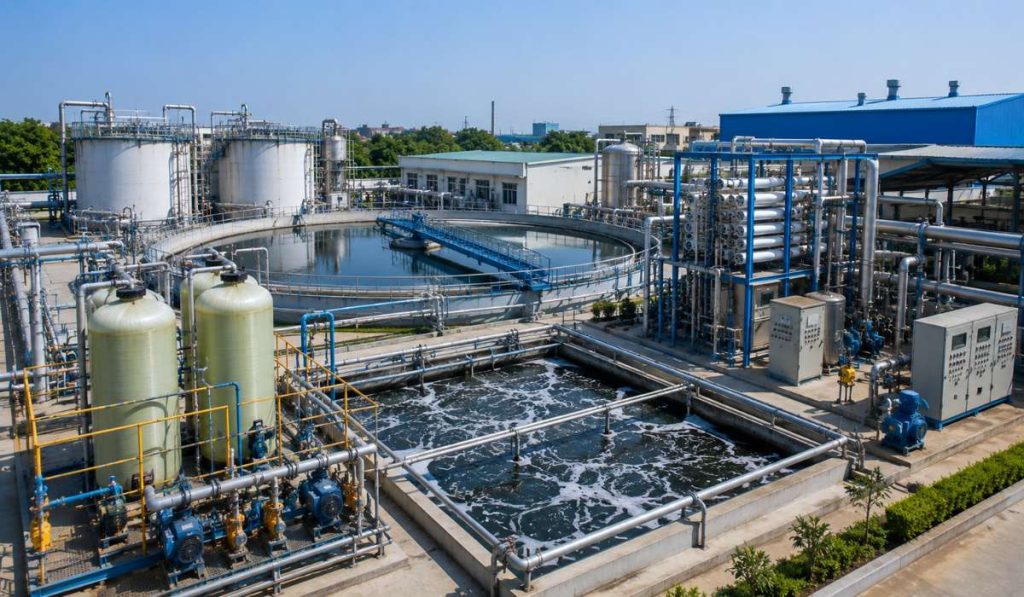
Standard ETPs use a single equalisation tank. Chemical plants frequently require segregated collection systems — separating high-COD process streams from lower-strength wash water, and isolating any stream containing heavy metals for separate pre-treatment before combining with the main effluent flow. This segregation prevents metals from passing untreated through biological stages.
Chemical Pre-Treatment for Metal Removal
Heavy metals — chromium, nickel, copper, zinc, lead — must be removed through chemical precipitation (typically hydroxide or sulphide precipitation) before biological treatment. This stage does not exist in standard food or domestic wastewater ETPs and is non-negotiable for chemical industry compliance.
Robust pH Neutralisation
Chemical effluent pH can swing from highly acidic to highly alkaline depending on the process batch. A two-stage neutralisation system with both acid and alkali dosing capability, combined with a buffer tank, is standard for chemical industry ETPs — far more robust than the simple pH correction used in food or textile applications.
Anaerobic Pre-Treatment for High COD
For COD levels above 10,000 mg/L, aerobic biological treatment alone is often impractical due to oxygen demand and tank sizing. Anaerobic pre-treatment — typically an Upflow Anaerobic Sludge Blanket (UASB) reactor — reduces COD by 60 to 80 percent before aerobic polishing, while also generating biogas that can offset plant energy costs.
Advanced Oxidation for Non-Biodegradable Compounds
Certain chemical compounds resist biological breakdown entirely. Advanced Oxidation Processes (AOP) — using ozone, hydrogen peroxide with UV, or Fenton’s reagent — break down recalcitrant organics into biodegradable fragments before or after biological treatment, depending on the specific compound class.
MPCB Red Category and Chemical Industries
The vast majority of chemical manufacturing units fall under MPCB Red Category — the highest scrutiny classification. This means:
Annual consent renewal instead of multi-year validity
More frequent and detailed inspections
Stricter documentation requirements for consent applications
Higher likelihood of ZLD being attached as a consent condition, particularly for capacity expansions
For a complete walkthrough of the MPCB consent process including category-specific requirements, read our MPCB Consent to Operate Maharashtra guide.
When ZLD Becomes Mandatory for Chemical Industries
MPCB has progressively expanded ZLD requirements for chemical sector units, particularly when:
Your facility is located in a water-stressed MIDC zone with limited or no CETP discharge capacity
You are applying for capacity expansion and current discharge load is already at consent limits
Your effluent TDS exceeds levels that local CETP infrastructure can accept
Your specific chemical sub-category has been notified for mandatory ZLD compliance
Unlike textile dyeing, where ZLD mandates are tied to notified clusters, chemical industry ZLD requirements are increasingly assessed case-by-case during consent review — making early feasibility assessment critical rather than optional. For a detailed framework on deciding between ETP, ETP+RO, and full ZLD based on your specific situation, read our ZLD vs ETP vs ETP+RO decision guide.
Chemical Industry ETP Cost in India
| Capacity | ETP Only | ETP + RO | Full ZLD |
|---|---|---|---|
| 25 KLD | ₹25 lakh to ₹50 lakh | ₹45 lakh to ₹75 lakh | ₹1.2 crore to ₹2.2 crore |
| 50 KLD | ₹40 lakh to ₹80 lakh | ₹70 lakh to ₹1.3 crore | ₹2 crore to ₹3.8 crore |
| 100 KLD | ₹70 lakh to ₹1.4 crore | ₹1.2 crore to ₹2.2 crore | ₹3.5 crore to ₹6.5 crore |
These ranges run higher than equivalent-capacity food or textile ETPs because of the additional chemical pre-treatment, metal removal, and frequently anaerobic stages required. For a detailed breakdown of standard ETP and STP cost factors applicable across industries, see our complete STP and ETP plant cost guide.
Common Mistakes in Chemical Industry Wastewater Treatment
Applying a standard biological ETP design without pre-treatment for toxicity. High-COD or metal-laden chemical effluent fed directly into biological treatment without adequate pre-treatment kills the microbial culture — causing complete treatment failure that can take weeks to recover from.
Underestimating batch-to-batch variability. Multi-product chemical plants often have wildly different effluent characteristics depending on which product is being manufactured. ETP design must account for the worst-case scenario, not the average.
Ignoring heavy metal removal until inspection finds non-compliance. Metals do not biodegrade. If your process generates metal-bearing wastewater and your ETP has no precipitation stage, you will fail consent parameters regardless of how well the biological stage performs.
Delaying ZLD feasibility assessment until consent renewal forces the issue. Chemical industries that wait until MPCB attaches a ZLD condition during renewal face compressed timelines and limited negotiating room on implementation schedule. Proactive feasibility assessment, even when ZLD is not yet mandated, protects your expansion plans.
How Weltreat Designs Chemical Industry ETP and ZLD Systems
Weltreat conducts detailed wastewater characterisation specific to your manufacturing process before any design work begins — identifying COD strength, pH variability, heavy metal content, and any compounds requiring advanced oxidation. Our chemical industry ETPs include appropriate metal precipitation, robust neutralisation, and anaerobic pre-treatment stages engineered for your specific effluent profile, not generic templates.
For ETP design and installation across Pune and Maharashtra’s chemical manufacturing clusters, visit our effluent treatment plant services page.
For chemical industries facing ZLD compliance requirements, visit our Zero Liquid Discharge systems page.
Frequently Asked Questions
Can a standard ETP treat chemical industry wastewater?
No, not reliably. Standard ETP designs built for food, textile, or domestic wastewater lack the chemical pre-treatment, metal precipitation, and robust pH neutralisation that chemical industry effluent requires. Using a generic ETP design for chemical wastewater typically results in biological treatment failure and consistent compliance violations.
Is ZLD mandatory for all chemical industries in Maharashtra?
Not universally, but ZLD requirements for chemical industries are expanding, particularly for facilities in water-stressed zones, those seeking capacity expansion, or those whose effluent TDS exceeds local CETP acceptance limits. MPCB increasingly evaluates ZLD requirements case-by-case during consent review for Red Category chemical units.
How do heavy metals get removed from chemical industry effluent?
Heavy metals are removed through chemical precipitation — typically hydroxide precipitation by raising pH, or sulphide precipitation for metals that resist hydroxide treatment. The precipitated metal sludge is then separated through clarification and disposed of as hazardous waste through MPCB-authorised channels.
What is anaerobic pre-treatment and why do chemical plants need it?
Anaerobic treatment uses bacteria that function without oxygen to break down very high-strength organic wastewater (COD above 10,000 mg/L) before aerobic biological polishing. It reduces the load on the aerobic stage, requires less energy than equivalent aerobic treatment of the same COD, and can generate biogas as a byproduct.
How much does chemical industry ETP cost compared to other industries?
Chemical industry ETPs typically cost 30 to 60 percent more than equivalent-capacity ETPs for food or general industrial wastewater, due to the additional pre-treatment stages — metal precipitation, robust neutralisation, and frequently anaerobic treatment — required for compliant operation.
Also Read
- Effluent Treatment Plant Complete Guide India
- MPCB Consent to Operate Maharashtra — Step by Step Guide
- ZLD vs ETP vs ETP+RO — Which System Does Your Industry Need
- STP and ETP Plant Cost India — Full Breakdown
Need a Chemical Industry Wastewater Assessment?
Weltreat Systems designs ETP and ZLD systems specifically engineered for chemical industry effluent across Pune and Maharashtra.
Call: 020-41228334 | WhatsApp: +91 9850974811 | Email: info@weltreatsystems.com