
-
Email us at:
info@weltreatsystems.com -
Call us on:
020 - 41228334 - Download Brochure

16
Mar 26The pharmaceutical industry in Pune is the backbone of the region’s economic growth, with manufacturing hubs in Pimpri-Chinchwad, Hadapsar, Ranjangaon MIDC, and Chakan driving innovation and production. However, this vital industrial activity comes with a significant environmental responsibility. Pharmaceutical manufacturing generates complex wastewater containing active pharmaceutical ingredients (APIs), solvents, and chemical residues that can be […]
Read more
23
Feb 26The Strategic Imperative of Zero Liquid Discharge (ZLD) for Pune’s Industrial Future
- February 23, 2026
Explore technical insights on Zero Liquid Discharge (ZLD) systems for Pune industries. Learn about RO-MEE-ATFD integration, compliance benefits, and feasibility considerations for pharma, chemical, and manufacturing sectors in Chakan, Pimpri-Chinchwad, and Ranjangaon MIDC.
Read more
15
Feb 26Understanding the STP and ETP plant cost in India is critical for any organisation that generates wastewater — whether it’s a residential complex, hotel, hospital, or manufacturing unit. With tightening environmental regulations, rising water scarcity, and increasing pressure to operate sustainably, investing in the right treatment system is no longer optional — it’s a business […]
Read more
01
Feb 26Why Wastewater Treatment Plants Are Critical for Industrial Operations
- February 1, 2026
- sewage treatment for industries, sewage treatment plant compliance, Water Treatment
Industrial wastewater treatment plants are critical for compliance, operational continuity, and cost control in a regulated, water-stressed industrial environment.
Read more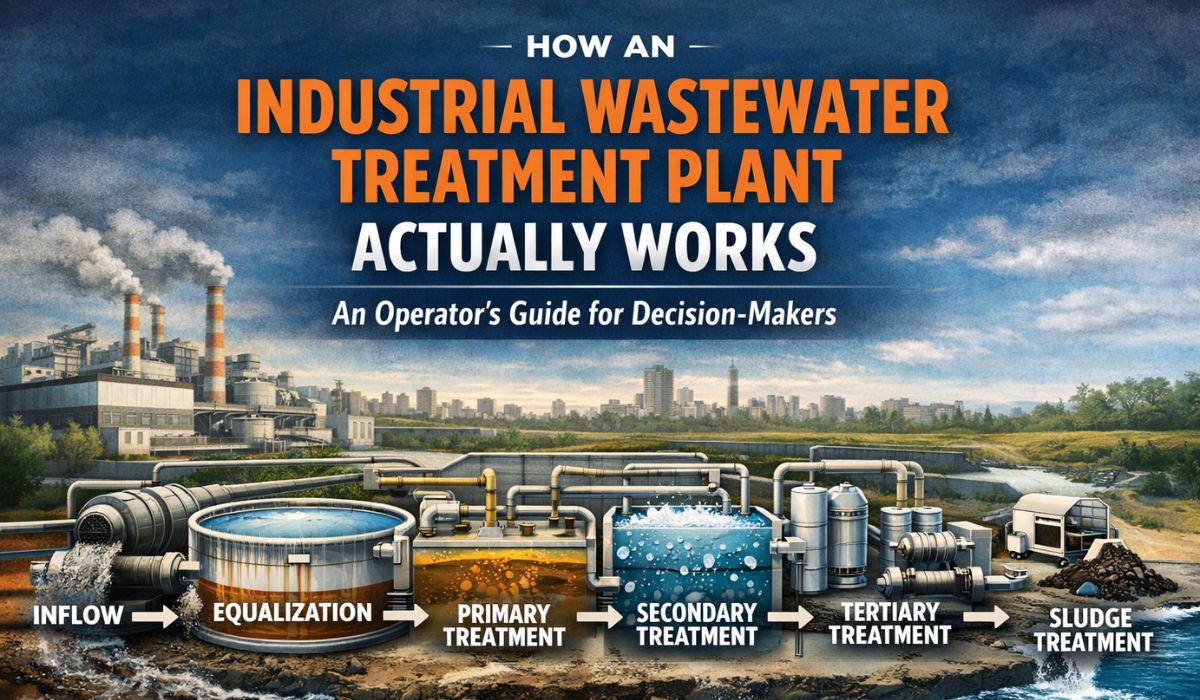
28
Jan 26How an Industrial Wastewater Treatment Plant Actually Works: An Operator’s Guide for Decision-Makers
- January 28, 2026
An industrial wastewater treatment plant is not a compliance checkbox—it is a live engineering system that directly affects operating cost, regulatory risk, and plant stability. This guide explains how industrial ETPs actually work under real operating conditions, from equalization to sludge disposal, and why design decisions—not equipment alone—determine long-term performance.
Read more
21
Jan 26Let’s get one thing straight at the start.Modern water threats are not driven only by climate change. Droughts and floods grab attention, but the most dangerous damage to water systems happens quietly and continuously. The biggest driver behind this slow collapse is man-made pollution, especially industrial effluents. This is not an emotional or activist argument. […]
Read more
27
Dec 25Industrial Sewage Treatment Plant Guide for Pune Industries
- December 27, 2025
This guide explains how industrial sewage treatment plants work in Pune industries. It covers treatment processes, STP vs ETP differences, compliance norms, design factors, cost basics, and operational challenges.
Read more
19
Dec 25Effluent Treatment Solutions in Pune: How Industries Can Avoid Costly Design Mistakes
- December 19, 2025
Many industries in Pune install effluent treatment plants without fully understanding their wastewater challenges. This guide explains common effluent treatment mistakes, treatment options, and how to choose the right solution before problems begin.
Read more
15
Dec 25Sewage Treatment Plant: Working Process, Types & Industrial Use Cases
- December 15, 2025
- commercial sewage treatment plant, CPCB sewage treatment norms, industrial sewage treatment plant, MBBR sewage treatment plant, SBR sewage treatment plant, sewage treatment for industries, sewage treatment plant, sewage treatment plant compliance, sewage treatment plant types, STP working process
A sewage treatment plant plays a critical role in industrial and commercial compliance. This guide explains how an STP works, the technologies used, and where facilities commonly make planning mistakes. Learn how proper STP design supports pollution control approvals, stable operations, and long-term cost control.
Read more
02
Dec 25Best Waste Water Treatment Solutions for Industries in Pune
- December 2, 2025
Industrial growth in Pune has increased wastewater generation and tightened compliance demands. This guide explains the best waste water treatment solutions for industries in Pune, covering ETP, STP, RO, MBR and ZLD systems to ensure regulatory compliance, water reuse and operational efficiency.
Read more