
-
Email us at:
info@weltreatsystems.com -
Call us on:
020 - 41228334 - Download Brochure

10
Jul 26Quick Answer: Hospitals in India are legally required to install and operate a Sewage Treatment Plant under NGT orders, CPCB norms, and state SPCB consent conditions. The specific STP capacity depends on bed count and daily water consumption. MBR technology is preferred for hospitals due to superior treated water quality and compact footprint. Non-compliance results in MPCB consent refusal, closure orders, and NGT penalties.
Hospitals are unique among institutional facilities when it comes to wastewater management. A hospital generates domestic sewage from toilets, kitchens, laundries, and OPDs — and simultaneously generates biomedical wastewater from operation theatres, ICUs, laboratories, dialysis units, and pharmaceutical preparation areas. These two streams have fundamentally different characteristics and require different handling approaches. Getting hospital wastewater treatment right is not optional — it is a licensing requirement, a patient safety matter, and an increasingly monitored compliance obligation across India.
Why Hospital Wastewater Is Different From Other Institutional Facilities
Quick Answer: Hospital wastewater contains pharmaceutical residues, antibiotic compounds, pathogens, blood, disinfectants, and radioactive tracers not found in commercial or residential sewage. Standard STP designs built for offices or housing societies consistently underperform when applied to hospital wastewater without specific engineering modifications.
Hospital sewage characteristics differ from standard domestic sewage in four important ways:
Higher pathogen load. Hospitals treat infectious patients. Their sewage carries bacteria, viruses, and antibiotic-resistant organisms at concentrations far higher than domestic sewage. Standard biological treatment achieves partial pathogen removal, but hospitals require reliable disinfection as a final polishing stage.
Pharmaceutical residues. Medications administered to patients pass through the body partially metabolised and enter the sewage stream. These pharmaceutical residues — including antibiotics, hormones, and chemotherapy agents — are not fully removed by conventional biological treatment. Activated carbon adsorption or advanced oxidation provides additional removal where required.
Disinfectant and chemical loading. Floor washing with phenolic disinfectants, bleach, and quaternary ammonium compounds enters the drainage system continuously. At high concentrations, these compounds are toxic to biological treatment microorganisms — the same organisms doing the work in your STP. Adequate equalization and dilution buffering is essential.
Radioactive tracers. Nuclear medicine departments use radioactive isotopes for diagnostic procedures. These tracers enter patient urine and reach the drainage system. Indian regulatory guidelines require decay-in-storage tanks for radioactive liquid waste — not direct entry to the STP.
NGT and CPCB Rules — What Applies to Hospitals
National Green Tribunal (NGT) Orders
The NGT has progressively tightened requirements for hospitals through multiple orders. Key requirements applicable across India:
All hospitals must have functioning STPs with treated water quality meeting CPCB General Standards before discharge to sewer or surface water.
Hospitals with more than 30 beds are specifically called out in several state-level NGT directions as requiring STP installation and operational compliance.
Hospital STPs must maintain treated water records and self-monitoring data available for inspection at all times.
CPCB Guidelines for Hospital Wastewater
CPCB has issued specific guidelines for hospital wastewater treatment that go beyond general standards:
Treated hospital sewage must meet BOD below 30 mg/L, COD below 250 mg/L, TSS below 100 mg/L, and total coliform below 100 MPN/100 mL for discharge to surface water or sewer.
For treated water used within the hospital campus for non-potable purposes — toilet flushing, garden irrigation, cooling towers — total coliform below 10 MPN/100 mL is recommended.
UV disinfection or chlorination as a final STP stage is specifically recommended for hospital sewage treatment to address pathogen loads.
Biomedical Waste Management Rules 2016
The Biomedical Waste Management Rules 2016 apply separately to liquid biomedical waste. Key requirements:
Liquid waste from operation theatres, ICUs, and laboratories that is blood-stained or potentially infectious must be treated before it enters the general Sewer.
Pre-treatment — autoclaving or chemical disinfection — is required for specific liquid biomedical waste categories before discharge to the STP.
Liquid waste containing radioactive isotopes must be stored in decay-in-storage tanks for a minimum of ten half-lives of the isotope before any disposal pathway.
MPCB Consent Conditions for Maharashtra Hospitals
In Maharashtra, hospitals fall under MPCB consent jurisdiction.Hospitals may require Consent to Establish (CTE) and Consent to Operate (CTO) from the respective State Pollution Control Board, depending on applicable regulations and project category. Read our MPCB consent to operate Maharashtra guide.
How to Calculate STP Capacity for Your Hospital
Quick Answer: Hospital STP capacity is calculated based on daily water consumption (typically 400 to 600 litres per bed per day for general hospitals, 700 to 900 litres per bed per day for super-specialty hospitals) with 80 percent of water consumption assumed to become sewage.
| Hospital Type | Water Consumption Per Bed Per Day | Sewage Generation (80%) |
|---|---|---|
| General hospital, basic facilities | 400 to 500 litres | 320 to 400 litres |
| Multi-specialty hospital | 500 to 700 litres | 400 to 560 litres |
| Super-specialty, ICU-heavy | 700 to 900 litres | 560 to 720 litres |
| Teaching hospital with attached residential | 900 to 1,200 litres | 720 to 960 litres |
Worked example: A 200-bed multi-specialty hospital with water consumption of 600 litres per bed per day generates approximately 120 KLD (kilolitres per day) of total sewage. STP capacity should be designed for this volume with a 20 to 25 percent safety factor — a 150 KLD STP is appropriate.
Important: Many hospitals undersize their STPs based on theoretical bed counts rather than actual water consumption. Actual water consumption measurement before STP design is essential — hospitals routinely consume 1.5 to 2 times the theoretical estimate due to operational laundry, kitchen, and OT water use.
Which STP Technology Is Best for Hospitals
Quick Answer: MBR (Membrane Bio-Reactor) is the preferred technology for hospital STPs because it produces the highest treated water quality — particularly for pathogen removal — in the most compact footprint. Where space or budget constrains MBR, MBBR with robust tertiary treatment (sand filter plus UV) is an acceptable alternative.
MBR (Membrane Bio-Reactor) — Recommended for Hospitals
MBR combines biological treatment with ultrafiltration membrane separation. Treated water quality: BOD below 5 mg/L, TSS below 2 mg/L, bacteria removal exceeding 99.99 percent. For hospital applications where treated water is reused for toilet flushing and irrigation within the campus, MBR with UV disinfection reliably meets CPCB guidelines.
Compact footprint is a major practical advantage for hospitals where plant room space is expensive and limited. MBR systems for hospital applications occupy 30 to 50 percent less space than MBBR plus clarifier configurations of equivalent capacity.
MBBR with Tertiary Treatment — Alternative
MBBR biological treatment followed by sand filtration and UV disinfection is a cost-effective alternative where full MBR investment is not viable. Treated water quality: BOD below 10 mg/L, TSS below 20 mg/L. Adequate for discharge compliance, and for non-critical non-potable reuse with UV disinfection.
SBR — Not Generally Recommended for Hospitals
SBR technology handles flow variation well but requires careful cycle management and produces treated water quality below MBR. For hospitals where treated water quality for internal reuse is important, SBR’s limitations make it less suitable unless specific site conditions favour it. For a detailed comparison of all three STP technologies, read our MBBR vs SBR vs MBR comparison guide.
Hospital STP — Complete Treatment Train
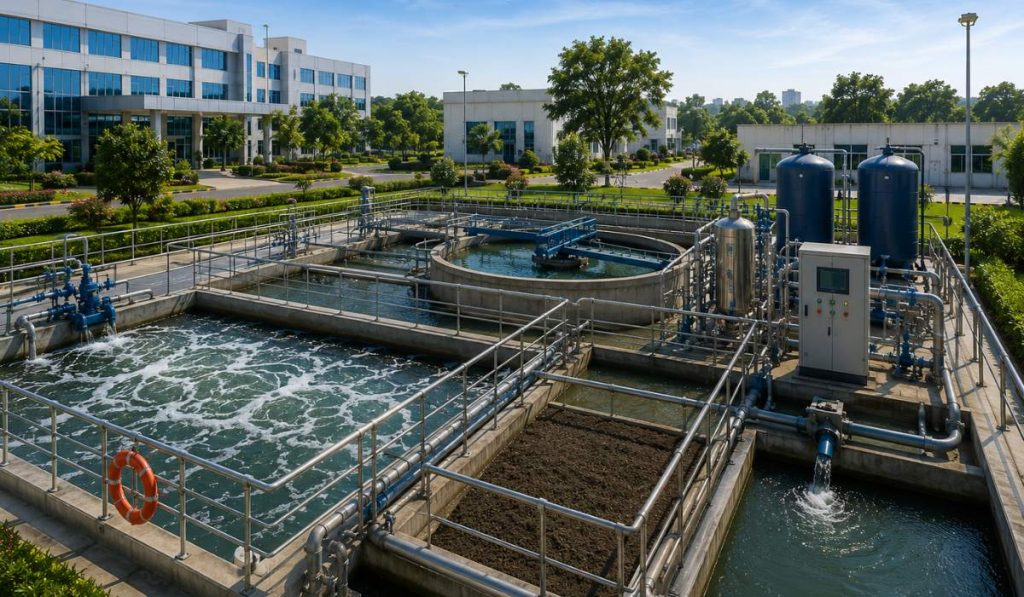
A properly designed hospital STP includes these stages:
Stage 1 — Equalization and pH Buffering
Hospital sewage varies significantly in composition and volume between day shift, evening, and night. An equalization tank of 6 to 8 hours capacity buffers these variations and dilutes disinfectant peaks before biological treatment.
Stage 2 — Screening
Bar screens remove surgical dressings, wipes, and other solid material that reaches drains despite housekeeping controls.
Stage 3 — Primary Settling
A primary clarifier removes settleable suspended solids before biological treatment — reducing load on the biological stage.
Stage 4 — Biological Treatment (MBBR or MBR)
The biological stage breaks down organic matter (BOD, COD) and reduces pathogen load through the natural die-off that occurs in biological treatment environments.
Stage 5 — Tertiary Polishing
Sand filtration followed by activated carbon where pharmaceutical residues require additional removal.
Stage 6 — UV Disinfection (Mandatory)
UV irradiation provides reliable, chemical-free inactivation of residual bacteria, viruses, and protozoa. UV disinfection is specifically recommended in CPCB hospital wastewater guidelines and should be included in every hospital STP regardless of other technology choices.
Stage 7 — Sludge Handling
Biological sludge from hospital STPs must be handled and disposed of carefully — it carries concentrated pathogens from the treatment process. Mechanical dewatering (filter press) and disposal through authorized channels is required. The entire STP sludge handling area should be treated as a controlled zone with appropriate containment.
Decay-in-Storage Tank (Nuclear Medicine Departments Only)
Hospitals with nuclear medicine departments must provide separate decay-in-storage tanks for radioactive liquid waste, sized for at least 10 half-lives of the longest-lived isotope used.
Hospital STP Cost in India
| Hospital Size | Recommended STP Capacity | Approximate Cost |
|---|---|---|
| 50 to 100 beds | 30 to 60 KLD | ₹15 lakh to ₹35 lakh |
| 100 to 200 beds | 60 to 120 KLD | ₹30 lakh to ₹65 lakh |
| 200 to 500 beds | 120 to 300 KLD | ₹60 lakh to ₹1.5 crore |
| 500+ beds, super-specialty | 300 KLD and above | ₹1.2 crore and above |
MBR-based systems run 30 to 50 percent higher in CAPEX than MBBR alternatives for the same capacity. The higher CAPEX is justified by superior treated water quality, smaller footprint, and lower risk of non-compliance during MPCB inspection.
For a detailed breakdown of STP cost factors across capacity ranges and technologies, read our complete STP and ETP plant cost guide.
Common Compliance Failures in Hospital STPs
Undersized equalization tanks. Peak morning sewage flow in hospitals is typically 3 to 4 times the average daily flow per hour. STPs designed without adequate equalization fail during peak load periods, causing biological treatment hydraulic overload.
Skipping UV disinfection to reduce cost. UV is non-negotiable for hospital applications. MPCB inspectors specifically check for UV system presence and operation. An STP without UV disinfection in a hospital setting will not pass inspection.
Not accounting for disinfectant peaks in drain lines. Scheduled floor cleaning with concentrated disinfectant periodically kills biological treatment culture. Equalization and dilution must buffer these peaks.
Inadequate sludge management. Hospital STP sludge is pathogen-rich. Leaving dewatered sludge on site without timely authorised disposal creates secondary contamination risk and MPCB liability.
Not registering the STP with MPCB. Many smaller hospitals install STPs but do not formally register them with MPCB or obtain formal consent. Operating an unregistered STP does not provide compliance protection — MPCB requires formal consent and periodic self-monitoring submission regardless of whether the STP is functioning correctly.
How Weltreat Designs Hospital STPs
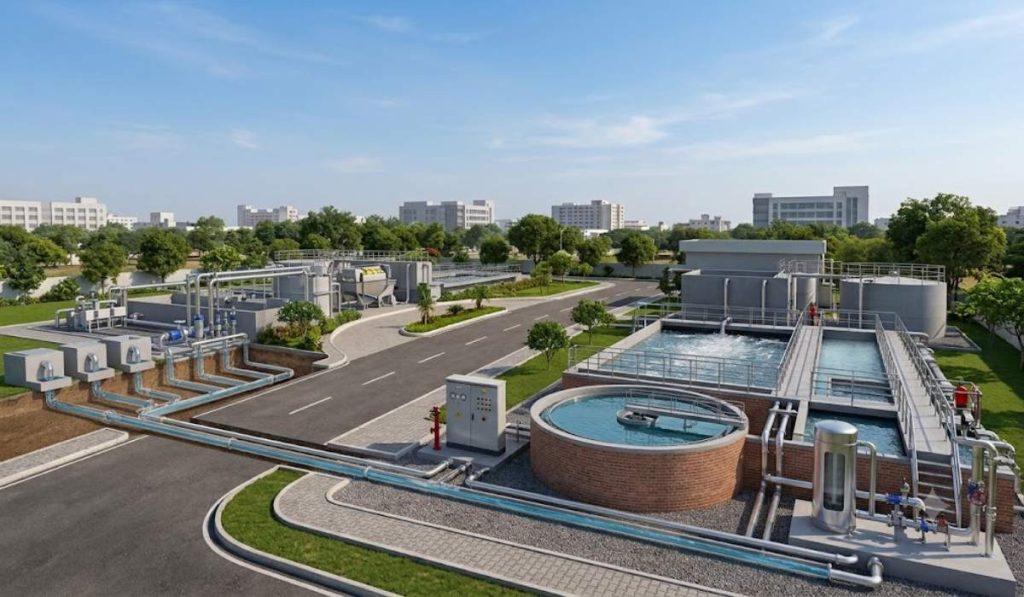
Weltreat Systems designs sewage treatment plants for commercial, institutional, and industrial applications. Hospital STPs require project-specific engineering to meet CPCB, NGT, and State Pollution Control Board requirements. Our team helps clients select suitable wastewater treatment solutions based on project requirements and applicable regulations.
To learn more about sewage treatment plant design, installation, and compliance solutions, visit our sewage treatment plant services page.
For hospitals that also operate pharmaceutical manufacturing or research facilities generating process effluent, an integrated ETP plus STP solution may be required. Read our effluent treatment plant complete guide to understand when both systems are needed.
Frequently Asked Questions
Is an STP mandatory for all hospitals in India?
Yes. NGT orders and CPCB guidelines effectively mandate STP installation for all hospitals that generate sewage. While specific bed-count thresholds vary by state, hospitals of 30 beds or more are consistently targeted by regulators across India. Hospitals without functioning STPs face consent refusal, penalties, and potential closure orders.
Does hospital STP treated water need disinfection before reuse within the campus?
Yes. CPCB guidelines specify that treated hospital sewage reused for non-potable purposes — toilet flushing, irrigation — must meet total coliform below 10 MPN/100 mL. This requires UV or chlorination as a final disinfection stage after biological treatment.
What is the difference between hospital STP and regular institutional STP?
Hospital STPs differ in three ways: higher pathogen load requiring mandatory UV disinfection, pharmaceutical and disinfectant loading requiring robust equalization and buffering, and regulatory oversight under both MPCB consent and Biomedical Waste Management Rules 2016 simultaneously.
Can biomedical liquid waste go directly into the hospital STP?
Not all categories. Liquid biomedical waste that is blood-stained or from infectious patients requires pre-treatment (chemical disinfection or autoclaving) before entering the STP. Radioactive liquid waste must go to decay-in-storage tanks, not the STP. Only pre-treated or non-hazardous sanitary sewage enters the main STP treatment train.
How long does it take to install an STP for a hospital?
A hospital STP of 50 to 150 KLD capacity typically takes 8 to 14 weeks from design finalisation to commissioning, including civil work. Weltreat provides a detailed project schedule at the proposal stage before commitment.
Also Read
- MBBR vs SBR vs MBR — Which STP Technology Is Right for Your Facility
- Sewage Treatment Plant Working Process Types and Industrial Use Cases
- MPCB Consent to Operate Maharashtra — Step by Step Guide
- STP and ETP Plant Cost India — Full Breakdown
- Why Wastewater Treatment Plants Are Critical for Industrial Operations
Need a Sewage Treatment Plant for Your Facility?
Weltreat Systems designs and supplies sewage treatment plants for commercial, institutional, and industrial facilities across Pune and Maharashtra. Our team provides project-specific STP solutions designed to meet CPCB, NGT, and MPCB compliance requirements.
Call: 020-41228334 | WhatsApp: +91 9850974811 | Email: info@weltreatsystems.com