
-
Email us at:
info@weltreatsystems.com -
Call us on:
020 - 41228334 - Download Brochure

22
May 26If you are evaluating a Sewage Treatment Plant for your industrial facility, hospital, housing society, or commercial complex, one of the most important decisions you will make is the choice of biological treatment technology. You will almost certainly encounter three options — MBBR, SBR, and MBR. Every vendor will have a preference, and every preference will come with a justification. This guide cuts through the sales arguments and gives you an objective comparison so you can make the right choice for your specific facility, budget, and performance requirements.
Why the Technology Choice Matters
The biological treatment stage is where the actual work of sewage treatment happens — where microorganisms break down organic matter, reduce BOD and COD, and produce treated water that is safe for discharge or reuse. The technology you choose for this stage determines:
- The physical size of your plant
- The quality of your treated water
- How much operator attention your plant needs
- What your system costs to build and run
- How your plant handles flow variation and shock loads
- Whether treated water is suitable for reuse
Getting this decision right from the start avoids the most expensive problem in STP operation — a technology mismatch that delivers consistently poor treated water quality or a plant that requires constant intervention to perform.
The Three Technologies — What Each One Actually Is
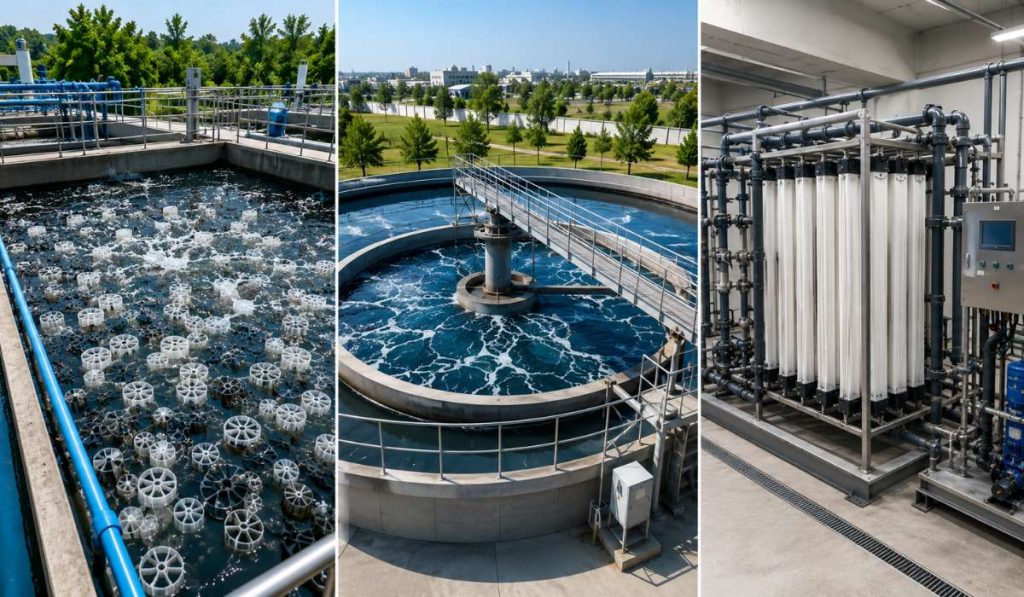
MBBR — Moving Bed Biofilm Reactor
MBBR uses plastic carrier media — small polyethylene pieces shaped like cylinders or wheels — suspended in an aeration tank. Microorganisms grow as a biofilm on the surface of these carriers. As wastewater flows through the tank, the biofilm treats it. Air diffusers keep the carriers in constant motion and supply oxygen to the aerobic biofilm.
The key characteristic of MBBR is that the biomass is attached to the carriers — it does not need to be settled and returned like in a conventional activated sludge system. This makes MBBR compact, stable, and resistant to operational upsets.
MBBR is widely used in India for industrial and commercial STP applications because it handles load variation well, requires relatively simple operation, and fits into compact footprints.
SBR — Sequential Batch Reactor
SBR treats wastewater in cycles within a single tank. Instead of continuous flow through multiple tanks, SBR fills a tank with wastewater, aerates it to promote biological treatment, allows solids to settle, decants the treated effluent, and then refills for the next cycle. All of this happens in one tank in a timed sequence.
The key characteristic of SBR is its flexibility. The cycle times can be adjusted to handle variable flows, and the single-tank design means less civil construction for the same treatment volume. SBR is common in applications with significantly variable daily flows — where a continuous-flow system would either be oversized for low-flow periods or undersized for peak periods.
MBR — Membrane Bio-Reactor
MBR combines biological treatment with membrane filtration in a single process. Microorganisms treat the wastewater in an aeration tank, and instead of a clarifier to separate treated water from biomass, ultrafiltration membranes directly filter the mixed liquor. Treated water passes through the membranes; biomass is retained.
The key characteristic of MBR is treated water quality. MBR produces effluent with very low TSS (near zero), low BOD and COD, and microbiological quality that conventional MBBR and SBR cannot match. MBR-treated water is directly suitable for toilet flushing, irrigation, and in many cases industrial cooling without further treatment.
The trade-off is higher capital cost and more intensive membrane maintenance.
Head-to-Head Comparison
| Factor | MBBR | SBR | MBR |
|---|---|---|---|
| Footprint | Compact | Moderate | Most compact |
| Treated water quality — BOD | Less than 10 mg/L | Less than 10 mg/L | Less than 5 mg/L |
| Treated water quality — TSS | 10 to 30 mg/L | 10 to 30 mg/L | Less than 2 mg/L |
| Treated water quality — bacteria | Moderate removal | Moderate removal | High removal |
| Suitability for water reuse | After sand filter + UV | After sand filter + UV | Direct reuse possible |
| CAPEX (relative) | Low to medium | Low to medium | Medium to high |
| OPEX (relative) | Low | Low to medium | Medium — membrane maintenance |
| Operator skill required | Low to medium | Medium — cycle management | Medium to high |
| Handling flow variation | Good | Very good | Good |
| Handling shock loads | Good | Good | Moderate — membrane sensitivity |
| Sludge production | Moderate | Moderate | Lower |
| Maintenance intensity | Low | Low to medium | Higher — membrane cleaning |
| Typical application | Industrial STP, commercial | Variable flow facilities | Water reuse, space-constrained |
MBBR — When It Is the Right Choice
MBBR is the most commonly recommended technology for industrial and commercial STP applications in India for good reason — it balances performance, cost, and operational simplicity effectively.
Choose MBBR when:
Your facility has relatively stable daily flow. Industrial facilities with fixed shift patterns, commercial buildings with predictable occupancy, and hospitals with consistent patient loads are well-suited to MBBR.
Your treated water is for discharge — not reuse. If your consent requires discharge to a sewer or CETP and you are not planning treated water reuse, MBBR with a sand filter and UV polishing delivers discharge-standard quality at the lowest total cost.
You want low operator intervention. MBBR systems, once stabilised, are relatively robust. They tolerate operational inconsistency better than SBR (which requires cycle management) and better than MBR (which requires membrane maintenance). For facilities where dedicated plant operators are not available, MBBR is the most reliable choice.
You have limited budget for capital cost but need proven technology. MBBR systems are cost-effective relative to the quality they deliver.
Practical example: A 200 KLD STP for an industrial complex in Pune MIDC with staff quarters and canteen — stable daily flow, treated water to be discharged to MIDC sewer. MBBR with tertiary sand filtration and UV is the appropriate and cost-effective choice.
SBR — When It Is the Right Choice
SBR suits facilities where flow variation is significant and operational flexibility matters more than the simplicity of MBBR.
Choose SBR when:
Your daily flow varies significantly. Facilities with seasonal production cycles, educational institutions that operate 9 months of the year, hotels with variable occupancy, and similar applications benefit from SBR’s adjustable cycle times.
You want a compact, single-tank design for civil simplicity. SBR’s single tank for both aeration and settling reduces the number of civil structures compared to MBBR + clarifier configurations.
You need nutrient removal. SBR can be configured for biological nitrogen and phosphorus removal — useful for facilities where the receiving water body or CETP has nutrient limits.
You have competent operators. SBR requires consistent monitoring of cycle performance and adjustment of timing parameters. Facilities with trained, dedicated plant operators get the best from SBR.
Practical example: A 300-room hotel in Pune with seasonal occupancy variation from 30 to 90 percent — treated water for garden irrigation. SBR’s flexible cycles handle the occupancy variation and deliver treated water quality suitable for irrigation after UV polishing.
MBR — When It Is the Right Choice
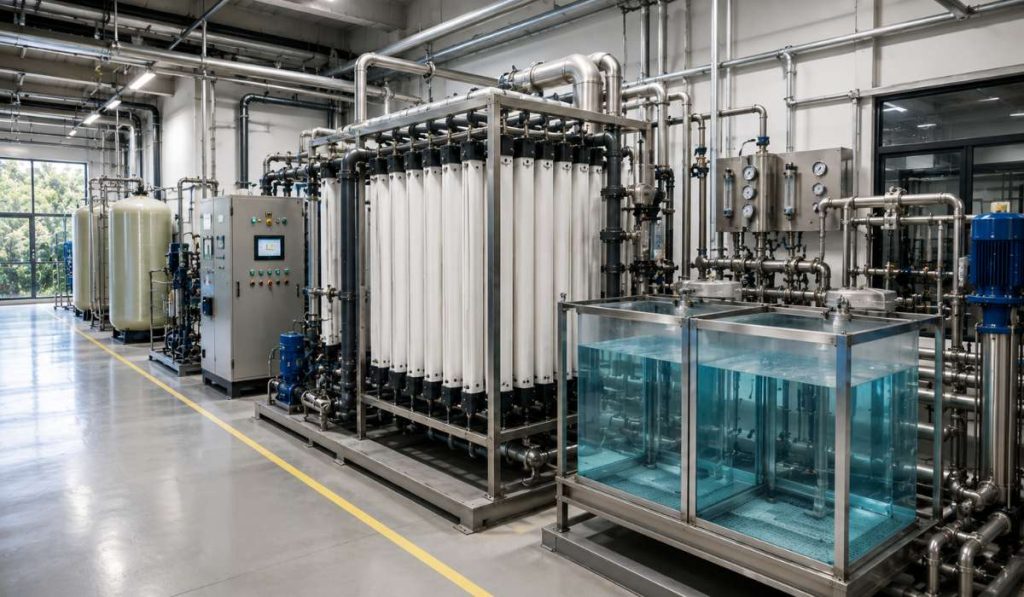
MBR is the right choice when treated water quality for reuse is the primary objective, or when site space constraints make conventional clarifier-based systems impractical.
Choose MBR when:
You need treated water suitable for direct reuse. MBR produces effluent with near-zero TSS and BOD typically below 5 mg/L. After UV disinfection, this water is suitable for toilet flushing, cooling tower makeup, and landscaping — without additional polishing filters.
Your site is severely space-constrained. MBR systems are the most compact biological treatment option because the membrane replaces the clarifier and polishing filter stages. For urban sites, basement installations, or facilities with minimal plant room space, MBR fits where other technologies cannot.
You are building a high-rise residential complex or commercial development. The Indian real estate sector increasingly specifies MBR for STPs because the treated water quality for toilet flushing compliance is straightforward to demonstrate, and the compact footprint suits urban building sites.
You are targeting green building certification. LEED, IGBC, and GRIHA certifications award points for on-site wastewater reuse. MBR treated water quality satisfies reuse criteria directly.
Practical example: A 500-flat residential complex in Pune where the builder needs STP compliance per NGT norms and wants to reuse treated water for toilet flushing and garden irrigation — with limited basement plant room space. MBR is the correct specification despite higher CAPEX because it meets reuse quality requirements in minimal footprint.
For a detailed guide on what STP options are available for commercial buildings and the NGT compliance requirements, read our complete sewage treatment plant guide for Indian industries.
Cost Comparison — What Each Technology Actually Costs
These ranges are for complete installed STP systems for a 100 KLD facility in Maharashtra including civil work, mechanical and electrical installation, and commissioning.
MBBR-based STP — 100 KLD Capital cost: ₹35 lakh to ₹65 lakh Monthly OPEX: ₹40,000 to ₹90,000
SBR-based STP — 100 KLD Capital cost: ₹30 lakh to ₹60 lakh Monthly OPEX: ₹45,000 to ₹95,000
MBR-based STP — 100 KLD Capital cost: ₹55 lakh to ₹1.1 crore Monthly OPEX: ₹70,000 to ₹1.5 lakh
The MBR OPEX premium is driven by membrane maintenance — periodic chemical cleaning, membrane replacement every 7 to 10 years, and higher energy consumption from membrane suction pumps.
For a broader comparison of STP and ETP installation costs, read our complete STP and ETP plant cost breakdown.
Hybrid Systems — MBBR+MBR
Many modern STP designs combine MBBR biological treatment with MBR membrane separation — MBBR provides the biological degradation and MBR provides the high-quality separation. This hybrid approach gets the operational stability of MBBR with the treated water quality of MBR, at a cost point between standalone MBR and conventional MBBR+clarifier.
For facilities that need high reuse quality but want better operational robustness than a pure MBR, MBBR+MBR hybrid is worth evaluating.
Common Mistakes When Choosing STP Technology
Choosing based on lowest quote. The cheapest technology quotation often reflects an undersized system, inferior membrane quality, or a generic design not sized for your actual flow and load. The most expensive STP problem is a correctly-priced system that was wrongly specified.
Choosing MBR for discharge-only applications. If your treated water will be discharged to a sewer and you have no reuse plan, MBR’s treated water quality premium is wasted capital expenditure. MBBR or SBR with tertiary polishing achieves discharge compliance at lower cost.
Choosing MBBR for variable-flow applications without a buffer tank. MBBR performs best with stable flow. For highly variable flows without an adequately sized equalisation or buffer tank upstream, MBBR performance suffers. Size your equalisation tank correctly or consider SBR.
Not planning for membrane replacement in MBR lifecycle cost. MBR membranes last 7 to 10 years and cost ₹5 lakh to ₹25 lakh for a 100 KLD system to replace. This must be in your lifecycle budget from day one.
Selecting technology without testing your actual sewage. Sewage from an industrial campus contains different loads than sewage from a housing society or hospital. Characterise your wastewater before specifying technology.
How Weltreat Recommends STP Technology
At Weltreat Systems, we evaluate STP technology for every project based on four factors — your actual wastewater characteristics, your treated water objective (discharge or reuse), your site constraints, and your operational capacity. We do not have a preferred technology to sell. Each project gets the technology that suits it.
For STP design and installation across Pune and Maharashtra, visit our sewage treatment plant service page.
For industrial facilities that generate both process effluent and domestic sewage, read about our effluent treatment plant solutions — many industrial sites need both an ETP and an STP.
And for MIDC industries specifically, check the compliance requirements in our MIDC ETP STP compliance checklist.
Frequently Asked Questions
Which is better — MBBR or MBR? Neither is universally better. MBBR is better when cost and operational simplicity are priorities and treated water is for discharge. MBR is better when treated water reuse quality is required or site space is severely constrained. The right choice depends entirely on your facility’s specific requirements.
Is MBR necessary for NGT compliance? No. NGT requires STPs to treat sewage to prescribed standards — it does not mandate a specific technology. MBBR or SBR with tertiary polishing can meet NGT standards for most applications. MBR is specified when the treated water reuse quality requirement goes beyond standard discharge compliance.
How long do MBR membranes last? MBR membranes typically last 7 to 10 years with proper operation and maintenance including regular backwashing and periodic chemical cleaning. Membrane life depends heavily on feed quality, operating flux, and maintenance discipline.
Can an MBBR-based STP be upgraded to MBR later? Yes, in most cases. If the aeration tank is sized appropriately, MBR membranes can be installed in or alongside the existing tank to replace the clarifier stage. This is a common upgrade path for facilities that install MBBR initially and later require higher treated water quality for reuse.
What treated water quality can I expect from each technology? MBBR and SBR with tertiary polishing: BOD less than 10 mg/L, TSS less than 20 mg/L, suitable for discharge. MBR: BOD less than 5 mg/L, TSS less than 2 mg/L, suitable for toilet flushing and irrigation after UV disinfection.
Also Read
- STP vs ETP — Key Differences Explained
- STP and ETP Plant Cost India — Full Breakdown
- MIDC ETP STP Compliance Checklist
- Why Wastewater Treatment Plants Are Critical for Industrial Operations
Get a Free STP Technology Assessment
Not sure which technology suits your facility? Weltreat Systems offers a free site evaluation and technology recommendation for STPs across Pune and Maharashtra. Our engineers assess your flow, load, space, and reuse requirements and recommend the most appropriate technology — without a preferred vendor position.
Call: 020-41228334 WhatsApp: +91 9850974811 Email: info@weltreatsystems.com