
-
Email us at:
info@weltreatsystems.com -
Call us on:
020 - 41228334 - Download Brochure

26
Jun 26Quick Answer: MPCB Consent to Operate (CTO) is a mandatory legal authorization for any industry in Maharashtra generating effluent, emissions, or hazardous waste. The process involves online application via mpcb.gov.in, document submission, fee payment, MPCB scrutiny, site inspection, and consent issuance — typically taking 30 to 120 days depending on industry category. Operating without valid CTO can result in closure within 24 hours.
Every industrial facility in Maharashtra that generates effluent, emissions, or hazardous waste requires consent from the Maharashtra Pollution Control Board to legally operate. Without valid MPCB consent, your facility faces closure orders, heavy penalties, and personal criminal liability for company directors. Yet the consent process confuses many facility managers — particularly those dealing with it for the first time, after an expansion, or during a renewal cycle. This guide explains the MPCB consent process clearly, practically, and completely.
What Is MPCB Consent to Operate?
MPCB Consent to Operate (CTO) is a legal authorization issued by the Maharashtra Pollution Control Board under the Water Act 1974 and Air Act 1981. It permits an industrial facility to legally operate after demonstrating that its pollution control systems — ETP, air pollution control equipment, and waste management — meet prescribed environmental standards. CTO is mandatory for every industry that generates effluent, air emissions, or hazardous waste in Maharashtra, with no exceptions for any sector.
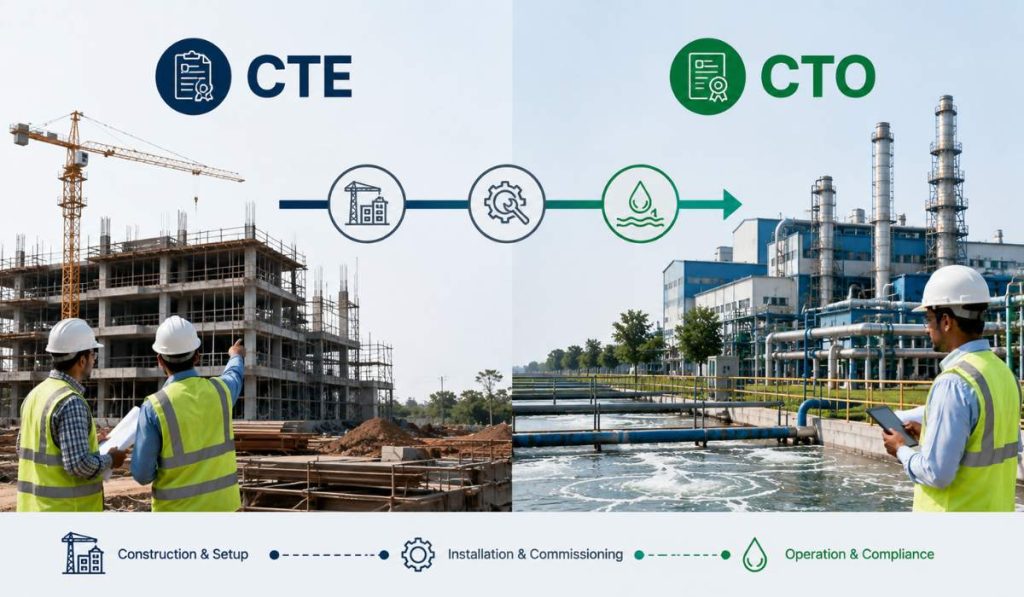
Two Types of MPCB Consent — CTE vs CTO
Consent to Establish (CTE)
Required before: Construction begins, or pollution control equipment is installed
Applies to: New facilities, expansions, process changes
Validity: One-time approval for the specific project
Consent to Operate (CTO)
Required before: Production operations begin
Applies to: Ongoing operations — must be renewed periodically
Validity: 1 to 5 years depending on category (detailed below)
If your facility is already running, CTO is the consent you must continuously maintain and renew. If you are planning a new facility or expansion, you need CTE first, then CTO before commissioning.
Who Does Not Need MPCB Consent to Operate?
Not every business in Maharashtra requires an MPCB Consent to Operate. Generally, CTO is required only when an activity generates industrial wastewater, air emissions, hazardous waste, or other forms of pollution regulated under environmental laws.
Businesses that typically do not require MPCB Consent to Operate include:
- Office buildings with no manufacturing activities
- Software and IT companies
- Consultancy firms
- Financial service providers
- Retail shops without industrial processing
- Educational institutions (unless operating laboratories or polluting utilities beyond prescribed limits)
However, if a business expands into manufacturing, installs diesel generators above applicable limits, generates hazardous waste, or starts any pollution-generating process, additional environmental approvals may become necessary. Always verify your specific applicability with the Maharashtra Pollution Control Board before commencing operations.
Which Industries Need MPCB Consent — Category Breakdown
MPCB classifies all industries into three categories. Your category determines documentation depth, inspection frequency, and consent validity period.
Red Category (highest scrutiny)
Industries included: Chemical manufacturing, pharmaceutical, textile dyeing, tanneries, sugar mills, distilleries, cement, pesticides
Consent validity: 1 year (annual renewal)
Inspection frequency: Most frequent
Orange Category (moderate scrutiny)
Industries included: Food processing, light engineering, plastic processing, printing, mid-size hotels
Consent validity: 3 years
Inspection frequency: Moderate
Green Category (lowest scrutiny)
Industries included: Many service industries, small-scale manufacturing, assembly operations
Consent validity: 5 years
Inspection frequency: Lowest
For MIDC-located industries specifically, additional location-based compliance applies regardless of category — see our complete MIDC ETP STP compliance checklist.
Complete Document Checklist for MPCB Consent
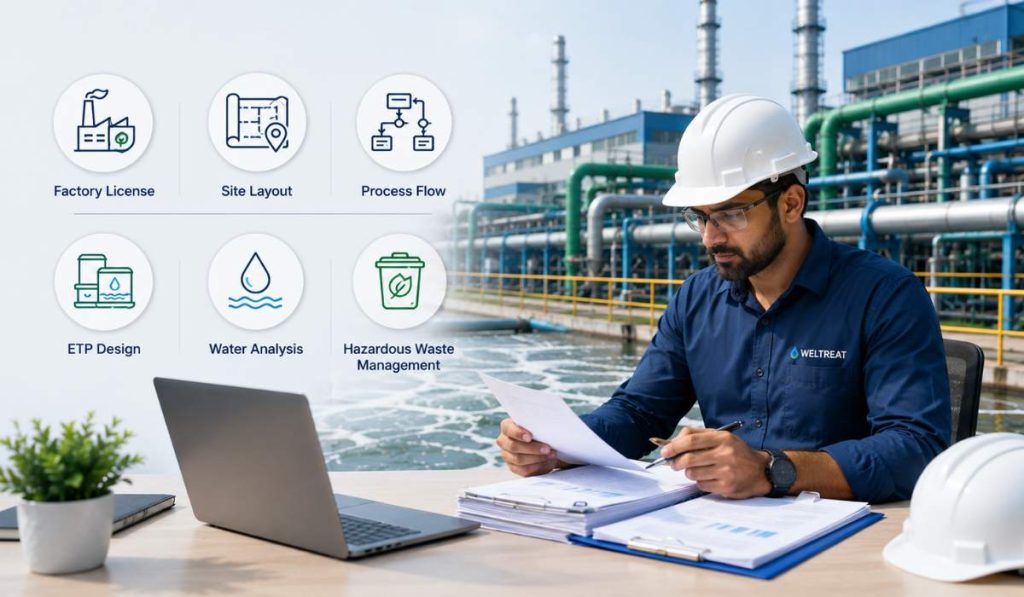
Documents required for every industry category:
- Industry registration — Udyam registration certificate or factory license from Director of Industrial Safety and Health
- Land ownership proof — 7/12 extract or registered lease deed
- Site layout plan — showing production area, ETP location, stormwater drainage, boundary
- Manufacturing process flow chart — raw materials, process steps, products, daily/monthly quantities
- Effluent generation data — daily volume in KLD, source points, characteristics (BOD, COD, TSS, pH, TDS)
- ETP design document — capacity, treatment stages, and projected treated effluent quality against MPCB standards
- Air emission inventory — sources, pollutants, quantities, control equipment fitted
- Solid and hazardous waste manifest — type, quantity, authorized disposal arrangement
Additional documents for Red Category industries:
- Environmental Impact Assessment — required above specified production capacity thresholds
- ZLD feasibility study — where MPCB has indicated zero discharge requirement
- Online Continuous Emission Monitoring System (OCEMS) connectivity plan — for large installations
For guidance on what a compliant ETP design document should contain, read our effluent treatment plant complete guide for Indian industries.
Common Mistakes That Delay MPCB Consent Approval
Many industries assume that submitting all documents is enough to obtain consent. In reality, technical inconsistencies are one of the biggest reasons applications remain pending.
The most common issues include:
- Selecting the wrong industry category (Red, Orange, or Green)
- Incorrect declaration of production capacity
- ETP design that does not match actual wastewater generation
- Missing hazardous waste authorization details
- Incomplete water balance calculations
- Poor-quality layout drawings or illegible uploaded documents
- Delayed responses to clarification queries raised by MPCB officers
Reviewing every document carefully before submission can significantly reduce approval delays and avoid repeated scrutiny.
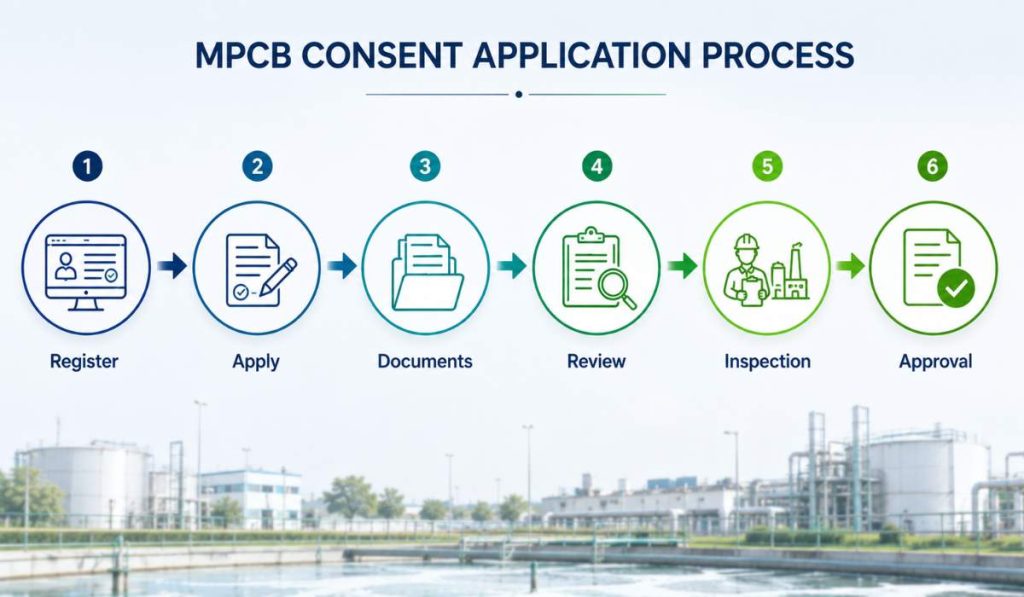
MPCB Consent Application Process — 7 Steps
Step 1 — Create your MPCB online account
Visit mpcb.gov.in. Register using company PAN and director’s Aadhaar. This account manages all future applications and renewals for your facility.
Step 2 — Complete the online application form
Select CTE or CTO. Enter production capacity, raw material list, utility consumption, effluent and emission data, and pollution control measures in place.
Step 3 — Upload all required documents
Submit clearly scanned PDFs. Illegible scans are the single most common cause of application delay.
Step 4 — Pay the consent fee
Fees scale by category and capital investment. Red Category typically ranges ₹25,000 to ₹1 lakh or higher for initial consent; Orange and Green categories pay proportionally less.
Step 5 — Respond to scrutiny queries
MPCB officers review submissions and frequently raise technical or documentation queries. Respond within the stipulated window — delayed responses are the leading cause of extended timelines beyond 90 days.
Step 6 — Site inspection
Red and Orange category facilities typically undergo physical inspection. Inspectors verify the ETP matches the design submitted, review operational logbooks, and may collect effluent samples for laboratory testing.
Step 7 — Consent issuance
On satisfactory review, MPCB issues digital consent specifying applicable discharge standards, operating conditions, validity period, and self-monitoring requirements.
MPCB Consent Timeline — What to Realistically Expect
| Category | Complete documentation | With query rounds |
|---|---|---|
| Green | 20 to 30 days | 40 to 50 days |
| Orange | 30 to 60 days | 60 to 90 days |
| Red | 60 to 90 days | 90 to 150 days |
Key insight: Incomplete or inconsistent documentation is responsible for roughly 60 to 70 percent of all timeline delays beyond these baseline estimates. Submitting a complete, technically sound application the first time is the single most effective way to control your consent timeline.
Consent Validity and Renewal Rules
Red Category CTO: 1 year — renew annually, apply 4 months before expiry
Orange Category CTO: 3 years — apply 4 months before expiry
Green Category CTO: 5 years — apply 4 months before expiry
Important: Operating with an expired CTO is legally identical to operating with no consent at all. There is no grace period once expiry passes without a renewal application on file.
What Your Consent Conditions Will Require You to Maintain
Once issued, your CTO specifies ongoing obligations:
Treated effluent quality — must continuously meet parameters specified in your consent, typically aligned with CPCB Schedule VI General Standards or stricter industry-specific limits.
Daily logbook maintenance — recording influent and treated effluent quality, chemical consumption, and operational status. MPCB inspectors review this first during any visit.
Self-monitoring and reporting — periodic laboratory testing by a NABL-accredited lab, with results submitted to MPCB at specified intervals.
No untreated discharge under any circumstance — including during ETP breakdown, maintenance, or capacity overload. Many enforcement actions in Maharashtra originate from bypass discharge during plant downtime.
Advance intimation of shutdowns — planned plant shutdowns must be reported to MPCB before they occur.
Consequences of Operating Without Valid Consent
| Violation Type | Possible Consequence |
|---|---|
| No consent at all | Closure Direction within 24 hours of detection |
| Expired consent | Treated identically to no consent |
| Discharge exceeding consent limits | Show Cause Notice, followed by Closure Direction if unresolved |
| Repeated violations | Monetary penalties under Environment Protection Act |
| Severe or willful violations | Criminal prosecution of directors and officers, including imprisonment |
Enforcement activity by MPCB has increased measurably across Maharashtra in recent years, particularly targeting facilities discharging without functioning treatment systems. For a cost reference if urgent ETP installation or upgrade is needed to restore compliance, see our complete ETP and STP plant cost breakdown for India.
ZLD and MPCB Consent — When It Becomes a Condition
For certain Red Category industries — particularly textile dyeing in notified clusters, tanneries, and select chemical categories — MPCB increasingly attaches Zero Liquid Discharge as an explicit consent condition, especially for expansion proposals. If your consent renewal or expansion application receives a ZLD condition, your ETP investment is not wasted — it becomes the pre-treatment foundation of the ZLD system. For a clear framework on when ZLD becomes necessary versus when ETP alone remains sufficient, read our ZLD vs ETP vs ETP+RO decision guide.
How to Avoid the Most Common Application Delay
Submit wastewater characterisation data, not assumptions. MPCB technical reviewers can identify ETP designs based on generic assumptions rather than actual site data. Real characterisation data strengthens your application significantly.
Match your application data to your actual facility precisely. Inconsistency between declared production capacity, effluent volume, and physical site inspection findings is a leading cause of application rejection.
Respond to queries within the stipulated window, not after. Many applications stall for months simply because a single technical query went unanswered for weeks.
Engage an experienced ETP design partner before submitting. A design document prepared by a vendor with direct MPCB consent experience is scrutinised faster than a generic submission.
How Weltreat Supports Your MPCB Consent Application
The ETP design document is the most technically scrutinised component of any MPCB consent application. Weltreat prepares ETP design documentation that meets MPCB requirements — including process flow diagrams, equipment specifications, and treated effluent quality projections — supporting your application from initial design through final commissioning and consent compliance.
For ETP design and installation across Pune and Maharashtra, visit our effluent treatment plant services page.
For facilities where ZLD is becoming a consent requirement, visit our Zero Liquid Discharge systems page.
Best Practices for Faster MPCB Approval
While every application undergoes technical scrutiny, industries can improve approval timelines by following a few practical best practices.
- Conduct wastewater characterization before finalizing the ETP design.
- Ensure production capacity matches all submitted documents.
- Upload clear, readable PDF documents.
- Respond promptly to clarification notices.
- Maintain updated records for water consumption and waste generation.
- Verify that pollution control equipment is fully operational before inspection.
- Keep all previous consent orders and compliance records readily available.
Proper preparation often reduces unnecessary correspondence and helps the application move smoothly through the approval process.
Frequently Asked Questions
How long does MPCB consent take in Maharashtra?
With complete documentation: Green category 20-30 days, Orange category 30-60 days, Red category 60-90 days. Incomplete documentation or unresolved queries can extend these timelines by 50 to 100 percent.
Can I start construction before getting Consent to Establish?
No. Starting construction without CTE is a regulatory violation that can result in demolition orders in addition to financial penalties.
What are the most common reasons MPCB consent applications are rejected or delayed?
Incomplete documentation, ETP design that does not demonstrably meet prescribed discharge standards, inconsistency between application data and physical inspection findings, and failure to respond to MPCB queries within the specified time window.
Do I need fresh consent for a capacity expansion?
Yes. Any increase in production capacity, addition of new processes, or change in raw materials requires fresh consent or a formal consent amendment before the expanded operation begins.
What is the difference between MPCB consent and Environmental Clearance from MoEFCC?
MPCB consent is required for all polluting industries regardless of size. Environmental Clearance from the Ministry of Environment, Forest and Climate Change is required only for large projects exceeding thresholds specified in the EIA Notification 2006. Large projects frequently require both approvals.
Can Weltreat help if my MPCB consent application was already rejected once?
Yes. Weltreat reviews the specific rejection reasons, corrects the technical gaps — most commonly in ETP design documentation — and supports resubmission with a stronger, characterisation-backed application.
Key Takeaways
Before applying for MPCB Consent to Operate, every industry should remember these essential points:
- Obtain Consent to Establish before construction and CTO before commercial operation.
- Maintain pollution control systems according to applicable standards.
- Submit complete and accurate documentation.
- Apply for renewal well before consent expiry.
- Respond promptly to technical queries raised by MPCB.
- Keep operational records updated for inspections.
- Never operate with an expired or invalid consent.
Following these practices helps industries remain compliant, avoid enforcement actions, and reduce delays during the consent approval process.
Also Read
- MIDC ETP STP Compliance Checklist
- Effluent Treatment Plant Complete Guide India
- STP and ETP Plant Cost India — Full Breakdown
- ZLD vs ETP vs ETP+RO Decision Guide
Why Proper ETP Design Matters for MPCB Consent
An Effluent Treatment Plant is not only an environmental requirement but also one of the most closely evaluated components during the consent process. MPCB officers review whether the proposed treatment system is capable of handling the industry’s actual wastewater characteristics and projected flow.
An undersized or improperly designed ETP can lead to repeated technical queries, additional documentation requests, or rejection of the consent application. Investing in an accurately engineered treatment system from the beginning helps industries achieve long-term compliance while reducing operational risks.
Need Help With MPCB Consent or ETP Design?
Weltreat Systems supports industries across Maharashtra with ETP design, documentation, and full MPCB consent application support.
Disclaimer
This guide is intended for general informational purposes only. Environmental regulations, consent validity periods, fee structures, documentation requirements, and compliance obligations may change based on amendments issued by the Maharashtra Pollution Control Board (MPCB) or other regulatory authorities. Industries should verify the latest requirements through official government notifications or seek professional environmental compliance advice before submitting an application.
Call: 020-41228334 | WhatsApp: +91 9850974811 | Email: info@weltreatsystems.com