
-
Email us at:
info@weltreatsystems.com -
Call us on:
020 - 41228334 - Download Brochure

23
Mar 26Industrial RO Plant Complete Guide in India: Working, Types, Capacity, Price and Applications
- March 23, 2026
Introduction
India’s industrial sector consumes large volumes of water every day. In manufacturing clusters across the country, groundwater is the primary source. However, groundwater in industrial areas often contains total dissolved solids (TDS) exceeding 1,500–5,000 ppm, along with high hardness, silica, iron, and sometimes heavy metals.
Municipal supplies are unreliable and may carry biological contaminants. For industries, these water quality issues directly affect production. Scaling in boilers, uneven dyeing in textiles, and contamination in pharmaceuticals lead to downtime, higher maintenance costs, and regulatory penalties.
To ensure consistent production and meet environmental norms, industries need reliable water purification systems.
The industrial RO plant is the most widely adopted technology for removing dissolved salts and impurities.
This guide provides a detailed, engineering-level explanation of how reverse osmosis systems for industry work, their components, capacity selection, pricing factors, and maintenance requirements—all tailored for the Indian industrial context.
What is an Industrial RO Plant and How Does It Work?
An industrial RO plant is a high‑capacity water treatment system that uses reverse osmosis to separate dissolved solids and contaminants from feed water.
The core principle is simple: pressure is applied to overcome natural osmotic pressure, forcing water through a semi‑permeable membrane. The membrane allows water molecules to pass while rejecting dissolved salts, organic compounds, and microorganisms.
Reverse Osmosis Membrane Filtration
Industrial RO membranes are typically spiral‑wound thin‑film composite (TFC) elements. They offer:
- Salt rejection: 97–99.5% for monovalent ions (sodium, chloride)
- Higher rejection for divalent ions (calcium, magnesium, sulfate)
- Physical barrier for bacteria, pyrogens, and colloidal silica
Industrial vs. Domestic RO Systems
While domestic RO units are designed for intermittent use at low flow rates, industrial RO plants operate continuously and are built to handle variable raw water quality. Key differences:
| Parameter | Domestic RO | Industrial RO |
|---|---|---|
| Capacity | 10–30 LPH | 500 LPH to >500 m³/day |
| Materials | Plastic, low‑pressure pumps | SS 316, FRP, multistage pumps |
| Pre‑treatment | Basic sediment & carbon | Multi‑media, softener, dosing |
| Automation | Manual or simple | PLC/SCADA with online monitoring |
| Operation | Intermittent | 24/7 continuous |
Industries require high‑capacity RO systems because process water demand is constant and any interruption affects production lines.
How Industrial RO Plants Work: Step‑by‑Step Process
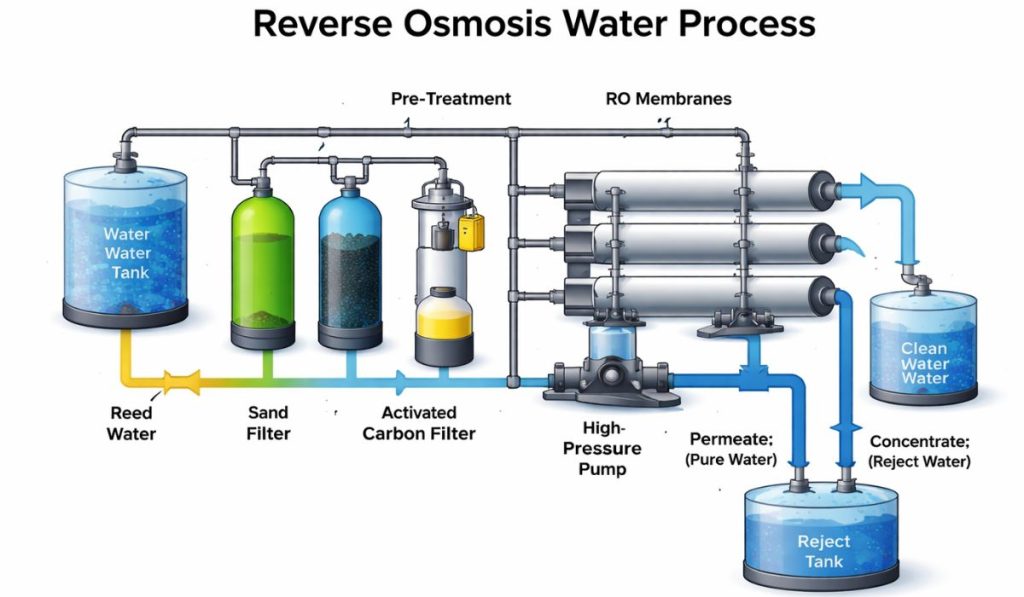
An industrial RO plant is designed as a staged treatment train. Each stage protects downstream equipment and ensures final water quality.
1. Raw Water Intake
Raw water is drawn from borewells, municipal supply, or surface sources into a storage tank. This tank provides hydraulic buffering, allowing the plant to operate independently of upstream fluctuations.
2. Pre‑Treatment System
Pre‑treatment is essential for membrane longevity. Without it, membranes foul or scale within weeks.
- Chlorination / Oxidation: Sodium hypochlorite is added to oxidize iron, manganese, and disinfect the water.
- Multi‑Media Filter (MMF): Graded layers of sand, anthracite, and gravel remove suspended solids down to 10–15 microns. Regular backwashing flushes out accumulated particles.
- Activated Carbon Filter (ACF): Granular activated carbon removes free chlorine and organic compounds. Chlorine above 0.1 ppm damages polyamide membranes.
- Water Softener: Cation exchange resin replaces calcium and magnesium with sodium, preventing carbonate scale on membranes.
- Cartridge Filters: Final guard filters (typically 5‑micron or 1‑micron) capture any fine particles that escaped upstream, protecting the high‑pressure pump.
3. High Pressure Pump
The high‑pressure pump raises feed water pressure to overcome osmotic pressure.
- Brackish water: 12–25 bar
- Seawater: 55–70 bar
Engineers use vertical multistage centrifugal pumps for continuous duty and energy efficiency.
4. Reverse Osmosis Membrane Filtration
Pressurized water enters pressure vessels containing spiral‑wound membranes.
- Water permeates through the membrane and is collected as permeate (purified water).
- Dissolved solids and particles are swept away as reject (concentrate).
Membranes are arranged in stages and arrays to optimize recovery (typically 60–75% for brackish water).
5. Permeate Water Production
The purified water is stored in a permeate tank. Depending on the application, it may be used directly or further polished by mixed bed deionizers, electrodeionization (EDI) , or UV disinfection.
6. Reject Water Disposal
The reject stream contains concentrated salts. In many Indian industries, it is sent to an effluent treatment plant (ETP) . In zero‑liquid discharge (ZLD) systems, reject is further treated in secondary RO stages, evaporators, and crystallizers to recover water.
Key Components of an Industrial RO Plant
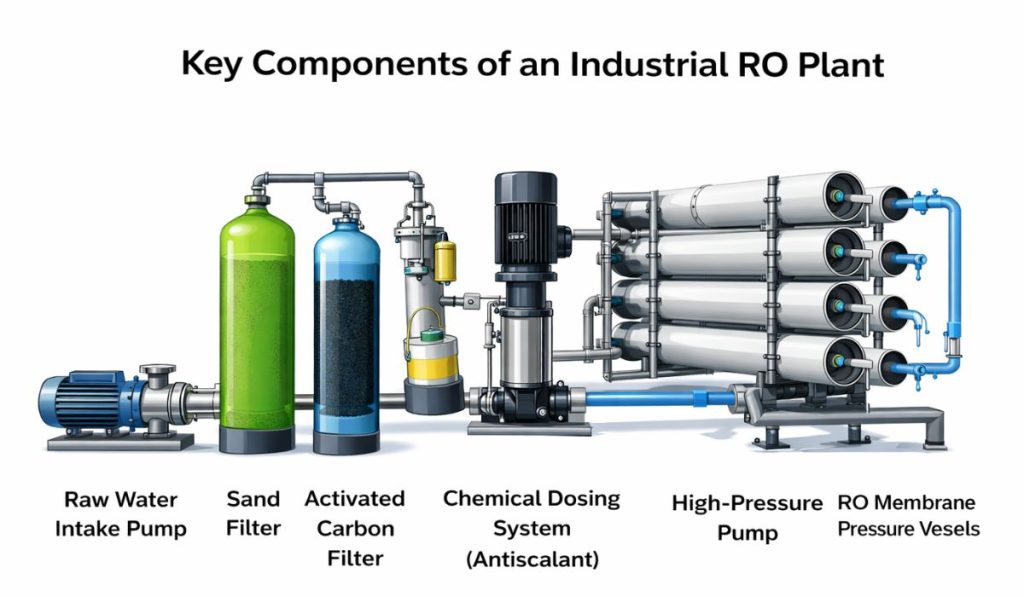
A well‑engineered industrial RO plant integrates several critical components:
- Feed Pump: Transfers raw water to pre‑treatment; sized to overcome head loss in filters.
- Multi‑Media Filter (MMF): Reduces suspended solids and silt density index (SDI).
- Activated Carbon Filter (ACF): Removes chlorine and organic compounds.
- Water Softener: Removes hardness via ion exchange; regenerated with salt.
- Chemical Dosing Systems: Antiscalant, sodium bisulfite, coagulant—each protects membranes.
- Cartridge Filters: 5‑micron absolute final guard.
- RO Membranes & Pressure Vessels: FRP or stainless steel vessels housing spiral‑wound elements.
- PLC Control Panel: Automates start‑up, shutdown, cleaning; monitors pressures, flows, conductivity.
All components are mounted on a structural skid to minimize footprint and simplify installation.
Types of Industrial RO Plants
Selecting the right configuration depends on feed water source and product water requirements.
| Type | Feed Water | Operating Pressure | Typical Applications |
|---|---|---|---|
| Brackish Water RO Plant | Borewell, river, municipal (TDS <10,000 ppm) | 12–25 bar | General manufacturing, boiler feed, cooling towers |
| Seawater RO Plant | Coastal water, high‑salinity (TDS 20,000–45,000 ppm) | 55–70 bar | Power plants, refineries, coastal desalination |
| Double Pass RO System | Permeate from first RO pass | 12–25 bar (second pass) | Pharmaceuticals (USP water), electronics, high‑purity boiler feed |
| Containerized RO Plant | Portable skid in ISO container | Varies | Remote sites, construction, emergency supply |
Brackish water RO is the most common in Indian manufacturing. Double pass RO achieves <10 µS/cm without chemical regeneration, making it ideal for high‑purity needs.
Industrial RO Plant Capacity: Selecting the Right Size
Capacity is expressed in liters per hour (LPH) or cubic meters per day (m³/day) . Proper sizing prevents bottlenecks and ensures continuous production.
| Capacity | Typical Industry / Application |
|---|---|
| 500 – 1,000 LPH | Small factories, laboratories, packaged drinking water plants |
| 1,000 – 2,000 LPH | Food processing, small dairy, medium hospitals |
| 2,000 – 5,000 LPH | Textile processing, medium pharmaceuticals, automobile ancillaries |
| 5,000 – 10,000 LPH | Large textile dyeing, chemical manufacturing, beverage plants |
| 10,000 – 50,000+ LPH | Power plants (boiler/cooling), integrated industrial parks, ZLD systems |
For continuous operations, engineers often specify n+1 redundancy (one extra unit) to allow maintenance without shutdown.
Industries That Use Industrial RO Plants
Different industries impose specific water quality standards; industrial RO plants are tailored to meet them.
- Pharmaceutical Manufacturing: Purified water (PW) and water for injection (WFI) require low conductivity, low TOC, and microbial control. RO is the primary treatment, often followed by EDI or distillation.
- Food and Beverage Processing: Water quality affects taste, clarity, and shelf life. RO removes chlorides, nitrates, and microorganisms, ensuring product consistency.
- Textile Industry: Hardness and metals cause dye precipitation and uneven shades. RO provides consistent soft water, improving dye uptake and reducing chemical costs.
- Chemical Industry: Trace ions can interfere with reactions. RO supplies demineralized water for synthesis, washing, and dilution.
- Power Plants: High‑pressure boilers need feed water with very low silica and conductivity. RO with mixed bed polishing is standard for makeup water.
- Electronics Manufacturing: Semiconductor fabrication requires ultra‑pure water (>18 MΩ·cm). RO upstream of CEDI and polishing loops removes particles and ions at sub‑ppb levels.
Industrial RO Plant Price in India: Key Factors and Estimates
The industrial RO plant price in India is influenced by multiple technical parameters. For B2B buyers, evaluating lifecycle costs—membrane replacement, energy, chemicals—is as important as the initial investment.
Factors Affecting Price
- Capacity: Larger capacities have higher absolute cost but lower cost per cubic meter.
- Raw Water Quality: Seawater or high‑TDS feed requires high‑pressure pumps, corrosion‑resistant materials (super duplex), and energy recovery devices, increasing cost.
- Membrane Type and Quantity: Imported membranes (DuPont, Hydranautics, Toray) offer longer life and consistent rejection, at a premium.
- Material of Construction (MOC): SS 316 is essential for high‑purity or corrosive environments; FRP and SS 304 are used for standard applications.
- Automation Level: PLC/SCADA systems add cost but reduce operator dependency and improve reliability.
- Installation and Civil Works: Containerized plants reduce civil costs; skid‑mounted units require plant rooms.
Approximate Price Ranges (Brackish Water, Standard Automation)
Indicative for typical project specifications.
| Capacity | Typical Configuration | Approximate Price Range (INR) |
|---|---|---|
| 500 LPH | FRP skid, semi‑automatic | 2.5 – 4.0 lakhs |
| 1,000 LPH | FRP/SS skid, automatic | 4.5 – 6.5 lakhs |
| 2,000 LPH | SS frame, PLC, 2‑stage | 7.0 – 10.0 lakhs |
| 5,000 LPH | PLC/SCADA, high recovery | 12.0 – 20.0 lakhs |
| 10,000 LPH | Custom engineered, civil tank foundation | 25.0 – 40.0 lakhs |
Seawater RO systems typically cost 1.5–2 times more than brackish water systems of the same capacity.
Benefits of Industrial RO Plants
From an engineering perspective, the benefits of installing an industrial RO plant are measurable:
- Consistent Water Quality: Maintains TDS, hardness, and silica within defined limits despite raw water fluctuations.
- Reduced Scaling and Fouling: Protects boilers, cooling towers, and heat exchangers, improving thermal efficiency and reducing fuel consumption.
- Longer Equipment Life: Minimizes corrosion and erosion in process equipment, extending mean time between repairs.
- Improved Production Quality: Eliminates variability caused by water impurities, reducing reject rates and enhancing product consistency.
- Environmental Compliance: Enables industries to meet discharge norms by reducing water consumption and enabling recycling. In zero‑liquid discharge (ZLD) systems, RO is the core recovery step.
Maintenance of Industrial RO Plants
Proper maintenance ensures reliable operation over 5–10 years. The key activities are:
Membrane Cleaning (CIP)
Membranes gradually foul with biofilms, colloids, and scale. Clean‑in‑Place (CIP) uses low‑pH and high‑pH chemicals, typically every 3–6 months, based on normalized pressure drop and flow.
Cartridge Filter Replacement
We change pre-RO cartridge filters when differential pressure reaches 1.0–1.5 bar. Frequency ranges from weekly to monthly depending on feed water quality.
Pressure and Flow Monitoring
Operators track feed pressure, inter‑stage pressures, and flow rates. A rise in differential pressure without flow change indicates fouling; a drop in normalized flow suggests scaling or membrane compaction.
TDS Monitoring
Online conductivity meters monitor feed, permeate, and reject. A sudden increase in permeate conductivity signals seal failure or membrane damage.
Preventive Maintenance Schedule
- Daily: Check pressures, flows, conductivity, chemical tank levels.
- Weekly: Inspect pumps for leaks, vibration; log parameters.
- Monthly: Backwash MMF/ACF; test water quality.
- Quarterly: Perform CIP if needed; calibrate instruments.
- Annually: Overhaul pumps; replace filter media (sand, carbon, resin) as required.
Industrial RO Plant Solutions in India
Every industrial facility has unique water conditions and production requirements. A standardized RO plant may not deliver optimal performance or cost efficiency. For this reason, engineering a custom solution is essential.
When designing an industrial water purification system, engineers evaluate:
- Raw water analysis (TDS, hardness, silica, iron, turbidity, microbiological)
- Required permeate quality (conductivity, pH, specific contaminants)
- Flow rate and operating hours
- Recovery rate target (typically 60–85% for brackish water)
- Space availability and civil constraints
- Integration with existing ETP or ZLD systems
Professional water treatment engineers conduct on‑site assessments, prepare detailed designs, and oversee installation, commissioning, and operator training. A properly engineered industrial RO plant reduces lifecycle costs and ensures compliance with regulatory standards.
If you are planning to install or upgrade an industrial RO plant, consulting a team with expertise in industrial water treatment is the first step toward a reliable, long‑term solution.
Future of Industrial Water Treatment in India
The industrial water landscape in India is evolving rapidly. Key trends shaping the future include:
- Water Scarcity: Declining groundwater levels in industrial clusters are pushing industries toward closed‑loop systems with high‑recovery RO (up to 90%).
- Stricter Pollution Norms: State pollution control boards are enforcing zero‑liquid discharge (ZLD) in sectors like textiles, tanneries, and pharmaceuticals. We have now integrated RO with evaporators and crystallizers.
- Wastewater Recycling: Industries increasingly use RO to treat secondary effluent from ETPs, producing recycled water for cooling and washing, reducing fresh water demand.
- Smart Monitoring (IIoT): Real‑time sensors and predictive analytics allow remote monitoring of membrane performance, chemical consumption, and energy use, enabling proactive maintenance.
- Energy Efficiency: Energy recovery devices (ERDs) are becoming standard in high‑pressure systems, cutting power consumption by up to 30%.
These developments will make industrial RO plants even more integral to sustainable manufacturing in India.
Frequently Asked Questions (FAQ)
1. What is the typical capacity of an industrial RO plant?
Capacities range from 500 liters per hour (LPH) for small units to over 50,000 LPH for large industrial plants. Selection depends on the facility’s water demand and operating hours.
2. How much does an industrial RO plant cost in India?
Cost varies by capacity, feed water quality, materials, and automation. A 1,000 LPH brackish water system typically costs ₹4.5–6.5 lakhs, while a 10,000 LPH system ranges from ₹25–40 lakhs. Seawater systems are 1.5–2 times higher.
3. What industries use industrial RO plants?
Key industries include pharmaceuticals, food and beverage, textiles, chemicals, power generation, and electronics manufacturing.
4. What is the lifespan of RO membranes?
With proper pre-treatment and maintenance, RO membranes typically last 3–5 years. Regular cleaning and monitoring extend their service life.
5. What is the difference between brackish water RO and seawater RO?
Brackish water RO treats water with TDS up to 10,000 ppm at 12–25 bar. Seawater RO handles TDS of 20,000–45,000 ppm at 55–70 bar and uses corrosion-resistant materials.
6. How is reject water managed in an industrial RO plant?
The system often sends reject (concentrate) to an effluent treatment plant (ETP). In zero-liquid discharge (ZLD) setups, it undergoes further RO stages, evaporation, and crystallization to recover water.
7. Can an industrial RO plant be used for wastewater recycling?
Yes. Industries commonly use secondary RO systems to treat ETP effluent, producing recycled water for non-potable applications such as cooling, washing, and boiler feed.
8. How do I choose the right industrial RO plant for my factory?
Start with a complete raw water analysis, define the required permeate quality, and consult an experienced industrial water treatment engineer who can design a system tailored to your process needs.
Conclusion
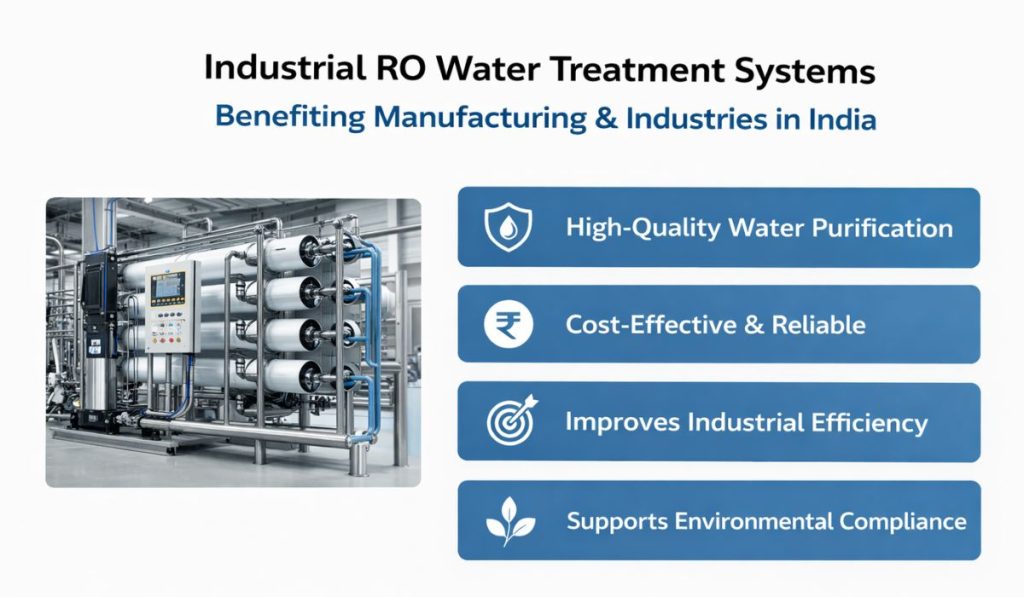
For industrial operations in India, water quality directly impacts efficiency, product quality, and environmental compliance. The industrial RO plant is a proven, scalable technology that reliably removes dissolved salts and impurities from a wide range of feed waters—from brackish groundwater to seawater and even treated effluent.
Selecting the right reverse osmosis system for industry requires careful analysis of raw water characteristics, capacity requirements, and integration with existing infrastructure. While the industrial RO plant price in India varies with technical specifications, the investment is justified by reduced downtime, extended equipment life, and adherence to regulatory standards.
As India moves toward stricter environmental norms and greater water reuse, industrial RO plants will remain at the core of sustainable water management. By combining robust engineering with proactive maintenance, industries can ensure their industrial water purification system delivers reliable performance for years to come.