
-
Email us at:
info@weltreatsystems.com -
Call us on:
020 - 41228334 - Download Brochure

27
Apr 26Every industry that operates an Effluent Treatment Plant (ETP) focuses heavily on one thing — treating wastewater to meet discharge standards. But there is a problem that sits quietly at the end of every treatment cycle, one that most industries underestimate until it becomes a serious liability.
That problem is sludge.
When an ETP removes contaminants from industrial wastewater, those contaminants do not simply disappear. They accumulate as a semi-solid or solid material called sludge. And if this sludge is not managed, treated, and disposed of correctly, it can lead to environmental violations, CPCB show-cause notices, heavy fines, and in some cases, plant shutdowns.
In Maharashtra alone, a significant percentage of ETP-related compliance violations are linked not to the treatment process itself, but to poor sludge handling and disposal. Industries spend lakhs of rupees building an ETP and then neglect the sludge that comes out of it — often storing it in open areas, mixing hazardous and non-hazardous waste, or disposing of it without proper documentation.
This guide is designed to change that. Whether you are setting up a new ETP, reviewing your current sludge handling process, or preparing for a pollution control board inspection, this is a complete, practical resource to help your facility manage sludge safely, compliantly, and cost-effectively.
Section 1: What is ETP Sludge?
ETP sludge is the solid or semi-solid residue that is generated when an effluent treatment plant removes pollutants from industrial wastewater. During the treatment process — whether physical, chemical, or biological — contaminants are separated from the water and concentrated into a thick, wet material. This material is sludge.
Sludge is an unavoidable by-product of wastewater treatment. The cleaner your treated water becomes, the more concentrated the sludge becomes. It contains heavy metals, organic compounds, chemical precipitates, microbial biomass, and other industrial pollutants depending on the nature of your effluent.
Under the Hazardous Waste (Management, Handling and Transboundary Movement) Rules, 2016, most industrial ETP sludge is classified as hazardous waste. This means it cannot simply be dumped in a landfill or left on the factory premises. It must be characterized, treated, transported, and disposed of following strict regulatory protocols.
Industries That Generate the Most ETP Sludge
- Pharmaceutical and API manufacturing
- Textile and dyeing units
- Chemical and petrochemical plants
- Metal finishing and electroplating units
- Food and beverage processing
- Tanneries and leather processing
- Paint and coating manufacturers
Section 2: Types of ETP Sludge
Not all sludge is the same. The type of sludge your ETP generates depends on which stage of the treatment process it comes from. Understanding this is critical because different types of sludge require different treatment and disposal approaches.
2.1 Primary Sludge
Primary sludge is generated in the first stage of ETP treatment — the physical separation stage. When wastewater enters the equalization tank and then the primary clarifier, heavy suspended solids settle at the bottom. This settled material is primary sludge.
- Composition: Raw suspended solids, sand, fibrous material, grease, oil
- Consistency: Dense, heavy, relatively easy to dewater
- Odor: Can be strong due to organic content
- Common in: Food processing, textile, tannery effluent
2.2 Secondary Sludge (Biological Sludge)
Secondary sludge is produced during the biological treatment stage of an ETP. In processes like activated sludge, MBBR, or SBR, microorganisms are used to break down organic pollutants in the wastewater. As these microorganisms multiply and eventually die, they form a biological mass called secondary sludge.
- Composition: Dead and live microbial biomass, undigested organics
- Consistency: Light, fluffy, difficult to dewater
- Volume: Often the largest sludge fraction in ETPs with biological treatment
- Common in: Pharmaceutical, food processing, domestic effluent mixed ETPs
2.3 Chemical Sludge
Chemical sludge is generated during the coagulation and flocculation stage of treatment. When chemicals like alum, ferric chloride, or lime are added to wastewater to remove dissolved pollutants, they form large clumps called flocs. These flocs settle and become chemical sludge.
- Composition: Chemical precipitates, heavy metal hydroxides, colloidal particles
- Consistency: Gelatinous, high water content, difficult to dewater
- Hazard level: Often high — may contain heavy metals like chromium, lead, zinc
- Common in: Metal finishing, electroplating, textile dyeing
Section 3: How Much Sludge Does Your ETP Generate?
One of the most common planning mistakes in ETP design is underestimating sludge generation. Many industries are caught off guard when they realize how much sludge their plant produces on a daily or monthly basis.
Sludge generation depends on several factors: the volume of wastewater treated, the concentration of pollutants in the influent, the treatment technology used, and the efficiency of dewatering equipment.
Typical Sludge Generation by Industry
| Industry | Wastewater Volume | Approx. Sludge Generated | Sludge Type |
| Pharmaceutical | 100 KLD | 300–800 kg/day (wet) | Chemical + Biological |
| Textile / Dyeing | 100 KLD | 500–1200 kg/day (wet) | Chemical + Primary |
| Food Processing | 100 KLD | 200–600 kg/day (wet) | Primary + Biological |
| Metal Finishing | 50 KLD | 100–400 kg/day (wet) | Chemical (Hazardous) |
| Chemical Plant | 100 KLD | 400–1000 kg/day (wet) | Chemical + Primary |
Note: These are approximate figures. Actual sludge generation depends on your specific effluent characteristics. A sludge audit by a qualified engineer is recommended for accurate estimation.
Section 4: ETP Sludge Treatment Methods
Raw sludge coming out of an ETP contains 95–99% water. Before it can be disposed of safely, it must go through treatment steps to reduce its volume, stabilize it, and make it suitable for compliant disposal. Here are the main sludge treatment methods used in Indian industries:
4.1 Thickening
Thickening is the first step in sludge processing. Its purpose is to increase the solids concentration in the sludge by removing free water, reducing the volume that needs to be handled in subsequent steps.
Gravity Thickener: Sludge is fed into a large circular tank where solids settle by gravity. Simple, low-cost, and widely used for primary sludge.
Dissolved Air Flotation (DAF): Air bubbles are introduced into the sludge, causing light solids (like biological sludge) to float to the surface where they are skimmed off. More effective for secondary sludge.
Output: Thickened sludge with 3–8% solids content, compared to 0.5–2% in raw sludge.
4.2 Dewatering
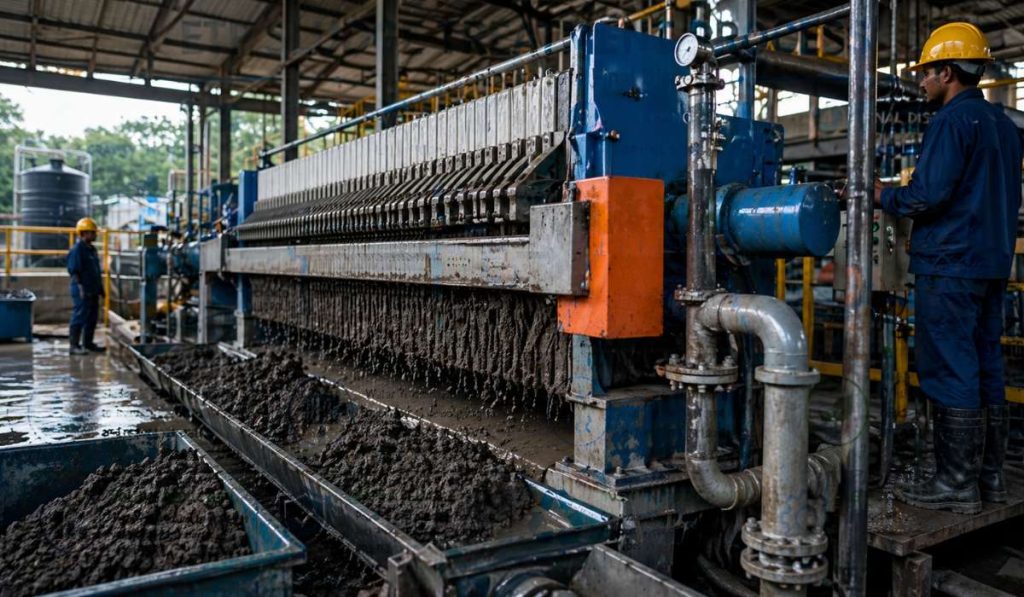
Dewatering is the most critical step in sludge management. It converts liquid sludge into a semi-solid cake that is significantly easier to handle, transport, and dispose of. Dewatered sludge typically contains 20–35% solids.
Filter Press: The most commonly used dewatering technology in Indian industries. Sludge is pumped into chambers between filter plates, and pressure is applied to squeeze out water. Produces a solid cake. Cost-effective and reliable.
Centrifuge: High-speed rotation separates solids from liquid. Produces drier cake than filter press and requires less space, but higher capital and operating cost. Preferred for pharmaceutical sludge.
Belt Press: Sludge is squeezed between two moving belts. Continuous operation, suitable for high-volume sludge. Common in textile and paper industries.
Screw Press: A slow-speed, low-energy dewatering option. Good for biological sludge. Lower maintenance requirements.
4.3 Drying
After dewatering, sludge may still contain significant moisture. Drying reduces moisture further, which is important before incineration or co-processing in cement kilns.
Solar Drying Beds: Dewatered sludge is spread on paved, covered beds and dried by solar heat. Low cost but requires large space and is weather-dependent. Suitable for non-hazardous sludge.
Mechanical Dryers: Rotary drum dryers or flash dryers use heat to reduce moisture to below 10%. Higher cost but suitable for hazardous sludge going for co-processing.
4.4 Stabilization
Stabilization reduces the biological activity, odor, and pathogen content of sludge before disposal.
Lime Stabilization: Adding lime raises the pH of sludge, killing pathogens and reducing odor. Simple and low-cost. Used before landfill disposal.
Anaerobic Digestion: Microorganisms break down organic matter in sludge without oxygen, producing biogas (energy) as a by-product. Reduces sludge volume by 30–50%. Suitable for high-organic sludge from food and beverage industries.
Section 5: ETP Sludge Disposal Options in India
Once sludge has been treated and dewatered, it must be disposed of through an authorized, compliant route. In India, the following disposal options are available, each with different cost, suitability, and compliance implications:
5.1 Co-Processing in Cement Kilns
This is the most preferred and widely used disposal method for hazardous industrial sludge in India. Cement kilns operate at extremely high temperatures (1400–1500°C), which completely destroy toxic compounds and pathogens. The mineral content of the sludge is incorporated into the cement clinker, leaving no residue.
- Best for: Pharmaceutical, chemical, textile, metal finishing sludge
- Advantage: Zero residue, high-temperature destruction of toxics, environmentally sound
- Cost: Moderate — cement companies may charge a tipping fee or accept for free depending on calorific value
- Requirement: Sludge must meet calorific value and composition norms of the cement plant
5.2 Secured Landfill (TSDF Facility)
Hazardous sludge that cannot be co-processed is disposed of at a Treatment, Storage, and Disposal Facility (TSDF) operated by the Maharashtra Pollution Control Board (MPCB) or private authorized operators. The sludge is placed in lined cells that prevent leaching into groundwater.
- Best for: Highly toxic sludge with low calorific value
- Advantage: Regulated, documented, compliant disposal
- Cost: Charged per metric tonne — varies by TSDF operator and sludge category
- Requirement: Manifest form must accompany each consignment
5.3 Incineration
High-temperature incineration (850–1200°C) is used for sludge containing volatile organic compounds, chlorinated solvents, or highly toxic materials. It destroys hazardous compounds and reduces sludge to ash.
- Best for: Pharma API sludge, solvent-contaminated sludge, high-toxicity chemical sludge
- Advantage: Complete destruction of organics
- Cost: High — most expensive disposal option
- Requirement: Must use authorized incinerator with proper air pollution controls
5.4 Bioremediation / Land Application
For non-hazardous sludge with low pollutant levels, bioremediation or land application may be permitted. Treated sludge is used to improve soil quality for non-food agricultural applications.
- Best for: Food processing sludge with low metal content after adequate treatment
- Advantage: Lowest cost, converts waste to resource
- Cost: Minimal
- Requirement: Sludge must be tested and certified as non-hazardous; PCB approval required
Disposal Method Comparison
| Method | Best For | Cost | Compliance Complexity | Residue |
| Co-processing | Pharma, Chemical, Textile | Moderate | Moderate | None |
| TSDF Landfill | High-toxicity sludge | Moderate-High | High | Minimal |
| Incineration | API, Solvent sludge | High | High | Ash only |
| Land Application | Non-hazardous sludge | Low | Low-Moderate | None |
| Bioremediation | Organic sludge | Low | Low | None |
Section 6: CPCB and Maharashtra SPCB Rules for Sludge Disposal
In India, ETP sludge management is governed primarily by the Hazardous Waste (Management, Handling and Transboundary Movement) Rules, 2016, along with guidelines from the Central Pollution Control Board (CPCB) and the Maharashtra Pollution Control Board (MPCB) for industries in Maharashtra.
6.1 How to Classify Your Sludge
Before you can dispose of ETP sludge, you must determine whether it is hazardous or non-hazardous. This is done through laboratory testing.
Schedule I: Processes generating hazardous waste — includes electroplating, pesticide manufacturing, pharmaceutical production, and many more. If your industry is listed here, your sludge is automatically classified as hazardous.
Schedule II: Constituents that make waste hazardous — heavy metals (chromium, lead, mercury, cadmium), cyanides, solvents, etc. If your sludge contains these above threshold limits, it is hazardous.
Schedule III: Hazardous characteristics — ignitability, corrosivity, reactivity, toxicity. Sludge exhibiting these characteristics is hazardous regardless of source.
6.2 The Manifest System
Every movement of hazardous sludge from your factory to a disposal facility must be accompanied by a Hazardous Waste Manifest Form. This is a tracking document that records the origin, quantity, nature, transporter, and destination of the sludge.
- The manifest is issued by the MPCB/SPCB through the online portal
- Copies must be retained by the generator, transporter, and disposal facility
- Annual returns must be filed with the pollution control board
- Loss of manifest records during inspection leads to compliance violations
6.3 Documents Your Facility Must Maintain
- Hazardous waste authorization (Form 1) from MPCB
- Sludge characterization report (lab test certificate)
- Copies of all manifest forms for the past 5 years
- Agreement with authorized TSDF/co-processor/incinerator
- Annual hazardous waste return filed with MPCB
- Storage area compliance records
6.4 Common Violations and Penalties
Under the Environment Protection Act, 1986, and the Hazardous Waste Rules, non-compliance with sludge management norms can result in:
- Show-cause notices and directions to stop operations
- Fines up to Rs. 1 lakh per day for continuing violations
- Criminal prosecution of responsible officers
- Closure of the facility until compliance is achieved
- Requirement to remediate contaminated land at company’s expense
Section 7: Common Sludge Management Mistakes Industries Make
After working with hundreds of industrial clients across Maharashtra, our team at Weltreat Systems has observed the same mistakes being repeated across different industries and sectors. Here are the most common ones:
Mistake 1: Not Accounting for Sludge During ETP Design
Many industries design their ETP for wastewater treatment capacity but forget to plan for sludge handling. There is no space allocated for sludge drying beds, no dewatering equipment procured, and no sludge storage area built. When the plant goes live, sludge accumulates with no place to go.
Mistake 2: Open Sludge Storage on Factory Premises
Storing ETP sludge in open areas on factory land — without lining, without cover, without authorization — is one of the most common violations. Rainwater can leach contaminants from open sludge piles into the ground and nearby water bodies. During PCB inspections, this is immediately flagged.
Mistake 3: Not Maintaining Disposal Records
Industries often send sludge for disposal without completing the proper manifest documentation. Some rely on informal disposal networks with no paperwork trail. During an MPCB audit, if you cannot produce 5 years of manifest records, you are considered non-compliant regardless of actual disposal.
Mistake 4: Choosing Disposal Method Based on Cost Alone
The cheapest disposal option is not always the compliant one. Some industries send hazardous sludge to unauthorized brick kilns or informal recyclers to save cost. This creates serious legal liability and can result in prosecution under environmental law.
Mistake 5: Mixing Hazardous and Non-Hazardous Sludge
When sludge from different treatment stages is mixed without characterization, it can result in non-hazardous sludge being contaminated with hazardous waste. This elevates disposal cost and compliance requirements for the entire batch. Always segregate sludge streams at the point of generation.
Mistake 6: No Sludge Characterization Testing
Many industries dispose of sludge without ever testing it in a laboratory. Without a sludge characterization report, you cannot correctly classify the waste, select the right disposal route, or demonstrate compliance to the pollution control board.
Section 8: How to Build a Sludge Management Plan for Your Facility
A structured sludge management plan is not just a regulatory requirement — it is good operational practice that saves cost, avoids crises, and protects your facility’s license to operate. Here is a step-by-step approach:
Step 1: Characterize Your Sludge
The foundation of any sludge management plan is knowing exactly what your sludge contains. Collect representative sludge samples from each stage of your ETP and send them to an NABL-accredited laboratory for analysis. Key parameters to test include: heavy metals, total dissolved solids, organic content, pH, ignitability, and leachate toxicity (TCLP test).
Step 2: Estimate Generation Volume
Based on your ETP capacity, treatment technology, and effluent characteristics, estimate how much sludge you generate per day, per month, and per year. Include both wet sludge volume and dewatered cake volume. This determines your storage requirements and disposal frequency.
Step 3: Select the Right Treatment Method
Based on your sludge type, volume, and available space, select appropriate dewatering and treatment equipment. For most medium-scale industrial ETPs in Pune, a filter press combined with gravity thickening is the most cost-effective solution. Larger facilities or those with biological sludge may benefit from a centrifuge.
Step 4: Choose a Compliant Disposal Route
Based on your sludge characterization results, identify the correct disposal category (Schedule I, II, or III) and select an authorized disposal facility — TSDF, co-processor, or incinerator. Enter into a formal agreement with the facility and obtain all necessary authorization.
Step 5: Set Up Documentation and Tracking
Register on the MPCB Hazardous Waste Online portal. Obtain your hazardous waste authorization. Train your ETP operator on manifest documentation. Establish a record-keeping system for all sludge movements. Set calendar reminders for annual return filing.
Step 6: Conduct Periodic Sludge Audits
At least once a year, conduct an internal sludge audit to verify that generation volumes match records, disposal documentation is complete, storage conditions are compliant, and characterization reports are current. This prepares you for PCB inspections and demonstrates due diligence.
Section 9: How Weltreat Systems Helps You Manage ETP Sludge
At Weltreat Systems Pvt. Ltd., we understand that sludge management is one of the most overlooked yet critical aspects of industrial ETP operation. Our team of engineers has helped industries across Pune, Pimpri-Chinchwad, Chakan, Ranjangaon MIDC, and Hadapsar design, implement, and maintain compliant sludge management systems.
Our Sludge Management Services Include:
- Sludge characterization and laboratory coordination through NABL-accredited labs
- Sludge audit — assessing current generation, storage, and disposal practices
- Dewatering system design, supply, and installation (filter press, centrifuge, screw press)
- Sludge drying bed design for non-hazardous applications
- Connecting industries with authorized co-processors, TSDF facilities, and incinerators in Maharashtra
- Assistance with MPCB hazardous waste authorization and documentation
- Annual compliance support and inspection preparation
- Operator training on manifest documentation and record keeping
Whether you are building a new ETP and want to plan sludge handling correctly from the start, or you have an existing plant and need to bring your sludge management into compliance, our team can provide end-to-end support.
Conclusion: Sludge is Not an Afterthought
In the world of industrial wastewater treatment, it is easy to focus on the water — on achieving the right BOD, COD, and TSS levels in your treated effluent. But the sludge that accumulates at the bottom of your clarifiers and tanks is just as important to manage.
Poor sludge management is one of the leading causes of environmental compliance failures in Indian industry. The consequences — fines, shutdowns, legal liability, and reputational damage — far outweigh the cost of setting up proper sludge treatment and disposal systems.
The good news is that with the right engineering guidance, compliant sludge management is not complicated or prohibitively expensive. It requires planning, the right equipment, proper documentation, and a relationship with authorized disposal partners.
If you are unsure about your current sludge management practices, or want to set up a new system that will stand up to MPCB scrutiny, reach out to the Weltreat Systems team today. We are here to help you manage your sludge — and your compliance — the right way.
Managing ETP sludge doesn’t have to be complicated — but it does have to be done right.
If you’re unsure whether your current sludge handling meets MPCB norms, or you’re setting up a new ETP and want to plan sludge management from day one, Weltreat Systems can help.
We’ve worked with pharma, textile, chemical, and food processing units across Pune and Maharashtra to set up compliant, cost-effective sludge management systems — from dewatering equipment to authorized disposal tie-ups.
Talk to our ETP sludge management experts — no obligation, just clarity on your next step.