
-
Email us at:
info@weltreatsystems.com -
Call us on:
020 - 41228334 - Download Brochure

14
Apr 26ZLD System Cost in India — Full Budget Breakdown by Capacity
- April 14, 2026
Zero Liquid Discharge (ZLD) is one of the largest capital investments an Indian industrial facility can make. Yet most industries approach ZLD projects without a clear understanding of what drives costs, what realistic budget ranges look like, or how to evaluate whether ZLD makes financial sense for their specific situation.
This guide gives you a detailed, honest breakdown of ZLD system costs in India — by capacity, by technology stage, and by operational expenditure — so you can plan your ZLD project with accurate numbers.
Why ZLD Cost Varies So Much
You will find ZLD cost estimates ranging from ₹50 lakh to ₹25 crore for a single project. This range is not misleading — it reflects genuine variation based on several factors.
Capacity is the biggest driver. A 50 KLD ZLD system and a 500 KLD ZLD system are fundamentally different projects in terms of equipment, civil work, and engineering.
Feed water quality matters enormously. High TDS feed water requires more evaporation energy. High organic content requires more pre-treatment. And high silica requires specialised membrane selection and anti-scalant programs.
Technology selection affects both CAPEX and OPEX. MEE (Multiple Effect Evaporator) is more capital-intensive than MVR (Mechanical Vapour Recompression) but may have lower operating costs at certain scales. ATFD (Agitated Thin Film Dryer) adds cost versus a crystalliser but is necessary for certain effluent types.
Site conditions — existing ETP infrastructure, available utilities (steam, electricity), civil work requirements, and land availability all affect the final project cost.
ZLD System Cost by Capacity — India 2025
These ranges are based on typical Indian industrial ZLD projects including ETP pre-treatment, RO stage, evaporation stage, and drying/crystallisation stage. Civil work is included. These are installed and commissioned system costs, not equipment-only supply costs.
50 KLD ZLD System Total project cost: ₹1 crore to ₹2 crore Suitable for: Small chemical units, small pharma facilities, limited textile operations Technology: ETP plus RO plus MEE plus ATFD
100 KLD ZLD System Total project cost: ₹2 crore to ₹4 crore Suitable for: Mid-sized pharmaceutical plants, medium chemical processing units Technology: ETP plus dual-pass RO plus MEE plus ATFD
250 KLD ZLD System Total project cost: ₹5 crore to ₹9 crore Suitable for: Large pharma facilities, medium textile dyeing units, large chemical plants Technology: ETP plus multi-stage RO plus MEE plus crystalliser
500 KLD ZLD System Total project cost: ₹9 crore to ₹16 crore Suitable for: Large textile dyeing units, large chemical complexes, industrial estates Technology: ETP plus multi-stage RO plus MEE plus MVR combination plus crystalliser
1000 KLD and Above Total project cost: ₹18 crore to ₹35 crore and above Suitable for: Very large industrial complexes, common effluent treatment plants (CETP), industrial parks Technology: Multiple process trains, advanced evaporation systems, full crystallisation
Cost Breakdown by Technology Stage
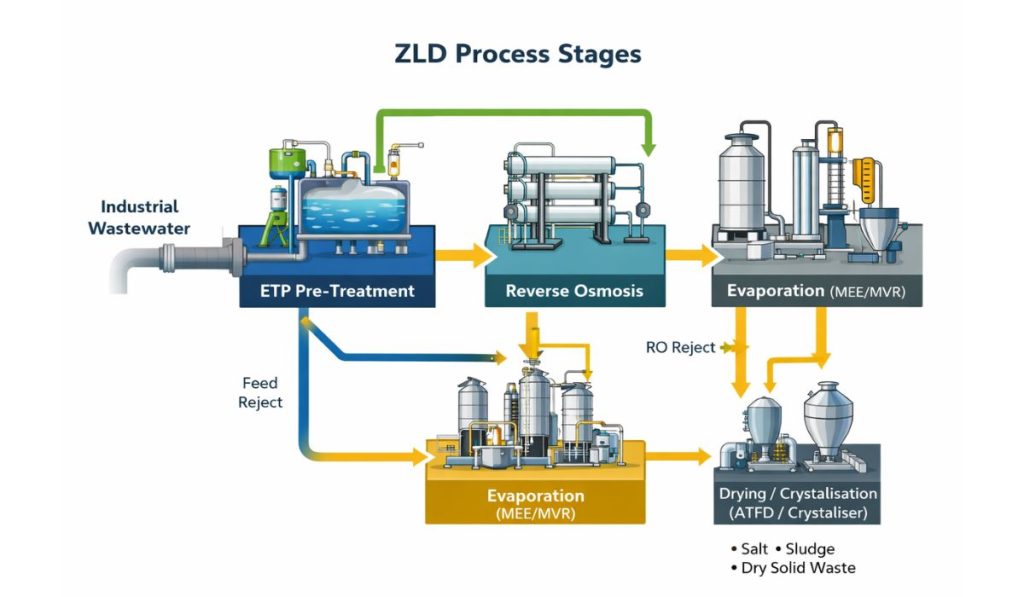
Understanding which stage costs what helps you plan your project and evaluate vendor quotes.
ETP Pre-Treatment Stage Percentage of total ZLD cost: 15 to 25% What it includes: Equalisation tank, primary treatment, biological treatment (MBBR or similar), clarifier, sludge handling Why it matters: Poor ETP pre-treatment increases fouling on RO membranes and increases evaporation load, raising OPEX significantly
Reverse Osmosis Stage Percentage of total ZLD cost: 20 to 30% What it includes: Antiscalant dosing, cartridge filters, high-pressure pumps, membrane vessels, CIP system Why it matters: RO recovery rate directly determines how much effluent goes to the expensive evaporation stage. Higher RO recovery means lower OPEX.
Evaporation Stage — MEE or MVR Percentage of total ZLD cost: 35 to 50% What it includes: Evaporator vessels, heat exchangers, vacuum systems, condensate recovery Why it matters: This is the most expensive stage and the highest OPEX driver. Steam consumption is the primary operating cost for MEE systems.
Drying Stage — ATFD or Crystalliser Percentage of total ZLD cost: 15 to 25% What it includes: Agitated thin film dryer or crystalliser, solid handling conveyors, storage Why it matters: Determines the final form of solid waste — dry powder (ATFD) or crystals (crystalliser). Affects downstream disposal logistics and cost.
ZLD Operating Expenditure — What to Budget Every Month
OPEX is often underestimated when industries focus only on CAPEX. For a 100 KLD ZLD system in India, monthly operating costs typically include:
Power consumption — ZLD systems are energy-intensive. Expect 8 to 15 kWh per kilolitre of effluent treated. At ₹8 per unit, a 100 KLD system running 25 days per month consumes ₹2 to ₹3.75 lakh in electricity alone.
Steam or thermal energy — MEE systems require steam. If you purchase steam or generate it from a boiler, budget ₹1.5 to ₹3 lakh per month for a 100 KLD system.
Chemicals — antiscalant, coagulants, pH correction chemicals, and CIP chemicals. Budget ₹40,000 to ₹1 lakh per month for a 100 KLD system.
Manpower — a ZLD system requires 2 to 4 trained operators per shift. Budget accordingly for your labour cost.
Solid waste disposal — ATFD cake or crystalliser solids must be disposed of through MPCB-authorised hazardous waste handlers. Budget ₹5,000 to ₹25,000 per tonne.
Maintenance and spares — budget 2 to 3% of CAPEX annually for maintenance.
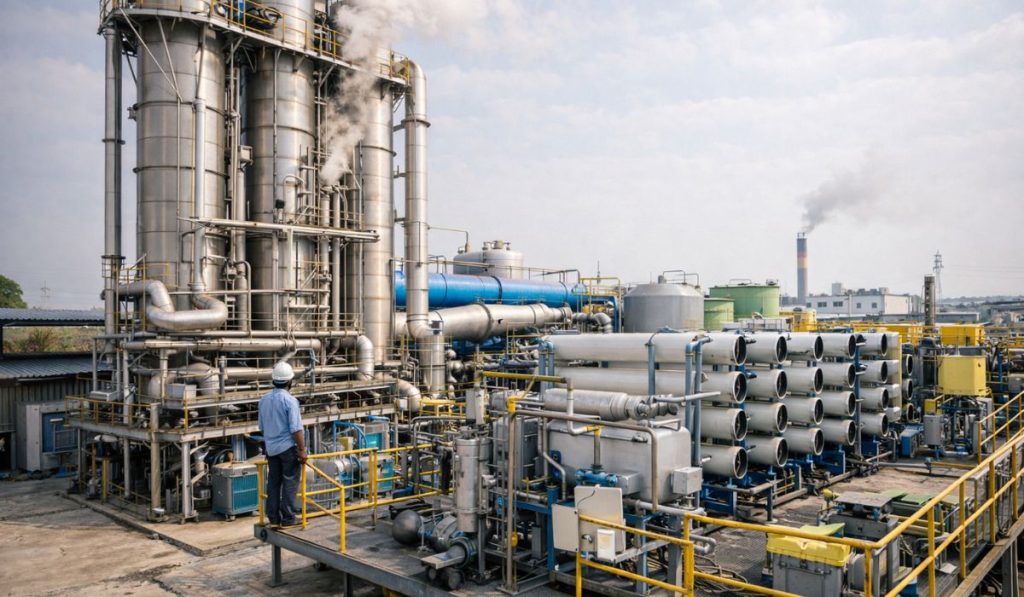
For a 100 KLD ZLD system, total monthly OPEX typically ranges from ₹5 lakh to ₹10 lakh depending on your utility costs and feed water characteristics.
How to Calculate ZLD Return on Investment
ZLD saves money in three ways. Calculating these against OPEX tells you whether ZLD makes financial sense.
If you want a practical estimate for your plant, including technology selection and actual operating cost, check this detailed breakdown of Zero Liquid Discharge (ZLD) System design and implementation.
Freshwater cost saving — every kilolitre of water recovered by your ZLD system is one kilolitre of freshwater you do not need to purchase or pump. If your current water cost is ₹50 to ₹200 per kilolitre, a 100 KLD system recovering 95 KLD saves ₹1.4 lakh to ₹5.7 lakh per month.
Effluent disposal cost saving — industries that currently pay for effluent tanker disposal or CETP charges save these costs with ZLD. Tanker disposal in Maharashtra typically costs ₹300 to ₹800 per kilolitre.
Regulatory risk avoidance — one MPCB closure order for a medium-sized plant costs ₹10 to ₹50 lakh in lost production per week, plus legal and remediation costs. ZLD eliminates this risk entirely.
For many industries with high freshwater costs and mandatory ZLD compliance requirements, payback periods of 4 to 7 years are achievable. For industries where ZLD is being proactively adopted, payback may be longer — 8 to 12 years — but the regulatory future-proofing value is significant.
When ZLD Does Not Make Sense
Weltreat will not recommend ZLD for every enquiry. ZLD is not economically viable when:
Your effluent volume is very small — below 20 to 30 KLD, the capital cost per unit of water recovered makes ZLD uneconomical compared to alternatives.
Your effluent is very low TDS — high-TDS effluent is necessary for ZLD to make sense. Low TDS effluent can often be treated and reused without full ZLD.
A treated discharge option exists — if MPCB permits discharge to a CETP or water body after treatment to standards, & this is cost-effective, ZLD may not be the right solution.
We conduct an honest feasibility assessment before any ZLD project recommendation.
Frequently Asked Questions
Is ZLD mandatory for my industry in Maharashtra?
ZLD is currently mandatory for textile dyeing and finishing units in notified clusters, tanneries, and certain categories of chemical industries in red-category zones in Maharashtra. For pharmaceutical and other industries, ZLD may be required as a consent condition depending on your location and discharge destination. Weltreat advises on your specific regulatory position.
What is the minimum capacity for a ZLD system?
Technically, engineers can build ZLD systems for any capacity. However, below 30 to 50 KLD, the capital cost per unit of effluent treated makes ZLD economically challenging. For very small volumes, alternative approaches may be more practical.
How long does ZLD project implementation take?
A complete ZLD system — from design finalisation to commissioning — typically takes 5 to 8 months for systems up to 250 KLD. Larger systems take 8 to 14 months. This includes procurement, fabrication, civil work, installation, and commissioning.
Can existing ETP be integrated into a new ZLD system?
Yes. If existing ETP is properly designed & operating well, it can serve as the pre-treatment stage for a new ZLD system. Weltreat assesses your existing ETP capacity and condition before integration.
What happens to the solid waste from a ZLD system?
The ATFD or crystalliser produces a dry solid containing concentrated salts and contaminants from your effluent. We classify this as hazardous waste and you must dispose of it through MPCB-authorised hazardous waste management facilities. We have included disposal costs in your monthly OPEX budget.
Related Guides –
Effluent Treatment Solutions in Pune
Zero Liquid Discharge (ZLD) Plant – Complete Info
Planning a ZLD project for your facility? Weltreat Systems offers free ZLD feasibility assessments for industries in Pune and Maharashtra. Call: 020-41228334 | WhatsApp: +91 9850974811 | Email: info@weltreatsystems.com