
-
Email us at:
info@weltreatsystems.com -
Call us on:
020 - 41228334 - Download Brochure

27
Dec 25Industrial Sewage Treatment Plant Guide for Pune Industries
- December 27, 2025
(Process, Compliance, Design & Operational Basics)
Industrial facilities in Pune generate large volumes of sewage every day. This sewage comes from employee washrooms, canteens, administrative blocks, utilities, and general cleaning activities. Treating this wastewater properly is no longer optional. Regulatory pressure, water scarcity, and increasing reuse requirements have made industrial sewage treatment plants (STPs) a critical infrastructure component for industries operating in and around Pune.
This guide explains what an industrial sewage treatment plant is, how it works, how it differs from an effluent treatment plant (ETP), applicable Pune regulations, and key design and operational considerations.
The content is written for engineers, plant managers, compliance teams, and industrial decision-makers.
This is not a sales article.
It is a technical and compliance-focused knowledge guide.
What Is an Industrial Sewage Treatment Plant?
An industrial sewage treatment plant is a system designed to treat domestic-type wastewater generated within an industrial facility. This sewage is different from manufacturing effluent and typically includes wastewater from:
- Toilets and washrooms
- Canteens and kitchens
- Administrative offices
- Utility areas and floor cleaning
Although this wastewater is similar to municipal sewage, industrial environments create variable flow and load patterns due to shift operations, workforce fluctuations, and intermittent usage. Because of this variability, industrial STPs must be more robust than typical residential systems.
The primary objectives of an industrial STP are:
- Compliance with environmental discharge standards
- Safe reuse of treated water within the premises
- Protection of surface water and groundwater
- Reduction of freshwater consumption
A common and costly misconception is treating industrial sewage casually because it appears “non-toxic.” In reality, poorly treated sewage can trigger regulatory action and operational shutdowns, especially during inspections.
How Industrial Sewage Treatment Plants Work
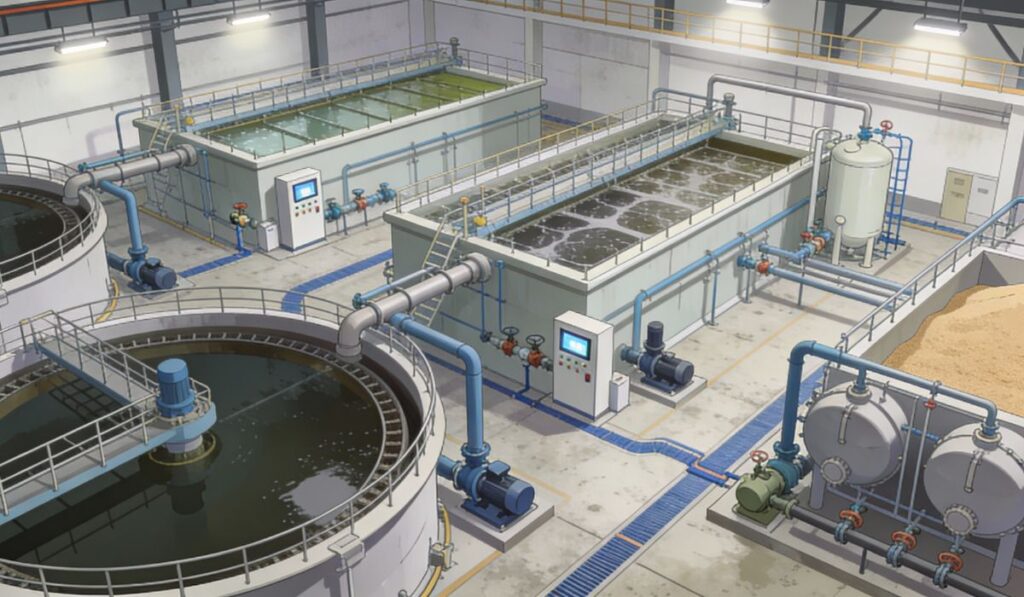
Industrial sewage treatment plants operate using a multi-stage treatment process. Each stage removes specific contaminants and prepares the wastewater for the next level of treatment.
At a high level, the process includes:
- Collection and flow equalization
- Primary treatment (physical removal of solids)
- Secondary treatment (biological degradation)
- Tertiary treatment (polishing and disinfection)
- Sludge handling and disposal
Every stage is interdependent. Skipping or undersizing any stage leads to unstable operation and compliance failure.
Key Stages of Sewage Treatment in Industrial Facilities
Preliminary and Primary Treatment
This is the first stage where physical contaminants are removed.
Incoming sewage passes through bar screens or fine screens to remove plastics, cloth, paper, and other floating debris. Grit chambers may be used to separate sand and heavy inorganic particles that can damage pumps and pipelines.
The wastewater then enters a primary settling tank, where suspended solids settle by gravity and floatable matter is skimmed off.
This stage:
- Reduces organic load on biological treatment
- Prevents clogging of downstream equipment
- Improves overall treatment efficiency
Inadequate primary treatment is one of the most common reasons for frequent STP breakdowns.
Secondary (Biological) Treatment
Secondary treatment is the heart of the sewage treatment plant. Here, microorganisms break down dissolved organic matter present in the sewage.
Common biological processes used in industrial STPs include:
- Activated Sludge Process (ASP)
- Moving Bed Biofilm Reactor (MBBR)
- Sequencing Batch Reactor (SBR)
The selection depends on factors such as:
- Available land area
- Flow and load variation
- Automation requirements
- Skill level of operating staff
Biological treatment requires careful control of oxygen levels, retention time, and sludge recycling. Most operational failures occur due to poor biological process control, not equipment defects.
Tertiary Treatment and Disinfection
Secondary-treated sewage may still contain fine suspended solids, nutrients, and pathogens. Tertiary treatment improves water quality further, especially when reuse is planned.
This stage may include:
- Pressure sand filtration
- Activated carbon filtration
- Chlorination or UV disinfection
In Pune, tertiary treatment is increasingly expected when treated sewage is reused for flushing, gardening, or cooling systems. Without adequate tertiary treatment, reuse leads to odor issues, scaling, and hygiene complaints.
Sludge Handling and Disposal
Sludge generated during primary and secondary treatment must be managed responsibly. Typical sludge handling steps include:
- Thickening
- Dewatering using filter presses or centrifuges
- Safe disposal as per regulatory guidelines
Ignoring sludge management results in odor problems, plant shutdowns, and serious compliance violations.
Difference Between STP and ETP in Industrial Facilities
One of the most common compliance mistakes in industries is confusing STPs with ETPs.
What an STP Treats
- Domestic sewage from washrooms, canteens, offices
- Biodegradable organic waste
- Relatively stable wastewater characteristics
What an ETP Treats
- Manufacturing and process wastewater
- Chemicals, dyes, solvents, oils, heavy metals
- High COD and non-biodegradable pollutants
| Parameter | STP | ETP |
|---|---|---|
| Waste source | Domestic sewage | Process effluent |
| Treatment core | Biological | Chemical + physical |
| Toxicity | Low | Medium to high |
| Reuse potential | High | Limited |
Many facilities attempt to treat sewage and effluent together to save capital cost. This approach often destroys biological activity and leads to chronic non-compliance. Regulators do not accept combined treatment explanations.
Correct practice is separate STP and ETP systems, with controlled reuse or discharge.
Sewage Treatment Plant Norms and Regulations in Pune
Industrial sewage treatment in Pune is regulated by national and state authorities.
- Central Pollution Control Board (CPCB) defines national discharge standards
- Maharashtra Pollution Control Board (MPCB) enforces these standards locally
Industries must comply with conditions mentioned in their Consent to Establish (CTE) and Consent to Operate (CTO).
Typical treated sewage standards (indicative) include:
- BOD: 10–20 mg/L
- COD: 50–100 mg/L
- TSS: 10–20 mg/L
- pH: 6.5–8.5
Actual limits depend on consent conditions and reuse or discharge type.
Common Sewage Characteristics in Industrial Facilities
Industrial sewage characteristics vary due to:
- Workforce size
- Shift patterns
- Canteen usage
- Cleaning frequency
Common characteristics include:
- Moderate BOD and COD
- Variable flow rates
- Occasional shock loads during peak hours
Designing an STP without accounting for these variations leads to unstable operation and frequent violations.
Key Design Considerations for Industrial STPs
When designing an industrial sewage treatment plant, the following factors are critical:
- Peak flow and load variation
- Space availability within the premises
- Future capacity expansion
- Ease of operation and maintenance
- Sludge handling and disposal method
- Reuse requirements
Under-designed STPs may work during low load but fail during peak operation.
Cost Factors of Industrial Sewage Treatment Plants
The cost of an industrial STP depends on multiple variables, including:
- Treatment capacity
- Selected biological process
- Level of automation
- Tertiary treatment requirements
- Sludge management system
Focusing only on capital cost often results in higher operating expenses and compliance risk over the plant’s lifecycle.
Common Operational Problems in Industrial STPs
Frequently observed issues include:
- Odor generation
- Foaming in biological reactors
- Poor sludge settling
- Inconsistent treated water quality
- High energy consumption
Most problems arise from inadequate monitoring and poor operational discipline, not equipment quality.
Why Industry-Specific STP Design Matters
While the treatment framework remains common, each industry has unique challenges. Chemical, pharmaceutical, textile, food, and power industries require customized STP designs based on their operational realities.
Understanding the fundamentals explained in this guide is essential before moving to industry-specific sewage treatment solutions.
Final Note
A properly designed and operated industrial sewage treatment plant is not just a compliance tool—it is a water management asset. Industries that invest in understanding sewage treatment fundamentals face fewer regulatory issues, lower operational disruptions, and better long-term sustainability.
FAQs
Q1. What is an industrial sewage treatment plant?
An industrial sewage treatment plant (STP) is a system used to treat domestic wastewater generated from washrooms, canteens, offices, and utility areas within an industrial facility so that it meets discharge or reuse standards.
Q2. What is the difference between an STP and an ETP in industries?
An STP treats domestic sewage that is biodegradable in nature, while an ETP treats manufacturing or process effluent that may contain chemicals, dyes, oils, or toxic substances. Both systems serve different purposes and should not be combined.
Q3. Is a sewage treatment plant mandatory for industries in Pune?
Yes. Industries in Pune are required to treat sewage as per MPCB and CPCB guidelines and comply with conditions mentioned in their Consent to Establish (CTE) and Consent to Operate (CTO).
Q4. Which regulations govern industrial sewage treatment in Pune?
Industrial sewage treatment in Pune is governed by standards issued by the Central Pollution Control Board (CPCB) and enforced locally by the Maharashtra Pollution Control Board (MPCB) through consent conditions.
Q5. Can treated sewage water be reused within industrial facilities?
Yes. Treated sewage water can be reused for applications such as toilet flushing, gardening, cooling tower makeup, and utility washing, provided it meets the required quality standards.
Q6. What factors affect the cost of an industrial sewage treatment plant?
The cost of an industrial STP depends on treatment capacity, selected process technology, automation level, tertiary treatment requirements, sludge handling system, and long-term operating needs.
Q7. What are the common operational problems in industrial sewage treatment plants?
Common issues include odor generation, poor sludge settling, foaming in biological reactors, inconsistent treated water quality, and high energy consumption, usually due to improper operation or inadequate monitoring.
Q8. How is sludge handled and disposed of in industrial sewage treatment plants?
Sludge is typically thickened, dewatered using filter presses or centrifuges, an