
-
Email us at:
info@weltreatsystems.com -
Call us on:
020 - 41228334 - Download Brochure

10
Jan 26Facilities often use the terms STP and ETP interchangeably, but engineers design sewage treatment plants (STP) and effluent treatment plants (ETP) for very different purposes. Selecting the wrong system or misunderstanding their roles leads to poor treatment performance, higher operating costs, and compliance challenges.
This blog explains the practical differences between STP and ETP systems, their applications, and how facilities should decide which treatment solution they require.
What Is an STP (Sewage Treatment Plant)?
A sewage treatment plant is designed to treat domestic and sanitary wastewater generated from residential societies, commercial buildings, offices, hotels, hospitals, and institutions. This wastewater mainly contains organic matter, suspended solids, and biological contaminants.
STPs primarily rely on biological treatment processes where microorganisms break down organic pollutants. Engineers design these systems to handle relatively stable wastewater characteristics with predictable organic loads.
Typical objectives of an STP include:
- Reduction of organic matter
- Removal of suspended solids
- Control of odor and pathogens
- Production of treated water suitable for reuse or discharge
In several mid-sized housing societies, sewage flow varies significantly during weekends and festival seasons. STP systems designed only on average capacity often struggle during peak load hours, leading to odor issues and inconsistent treated water quality.
Why this works:
✔ Real-life scenario
✔ Pune mention nahi (safe)
✔ Design insight shows expertise
What Is an ETP (Effluent Treatment Plant)?
An effluent treatment plant is designed to treat industrial wastewater generated from manufacturing and processing activities. Industrial effluent varies widely in composition and may contain chemicals, oils, heavy metals, high organic load, and dissolved solids.
ETPs often combine physical, chemical, and biological treatment stages to address complex wastewater characteristics. Design complexity increases compared to STPs due to variability in effluent quality.
Industries commonly use ETPs in:
- Manufacturing units
- Chemical and pharmaceutical plants
- Food and beverage processing facilities
- Engineering and fabrication industries
In manufacturing facilities, effluent composition may change with production schedules or raw material variations. ETP systems that are not designed for such variability frequently face treatment instability and higher chemical dosing requirements.
✔ Industrial reality
✔ No industry name
✔ Engineering-first tone
Key Differences Between STP and ETP Systems
Nature of Wastewater
STPs treat domestic sewage with relatively consistent characteristics, while ETPs handle industrial effluent with fluctuating chemical composition.
Treatment Processes
STPs rely mainly on biological treatment, whereas ETPs use a combination of chemical neutralization, physical separation, and biological processes.
Design Complexity
ETPs require more detailed wastewater analysis and process control due to variable influent conditions.
Operational Challenges
STPs face challenges related to odor control and sludge handling, while ETPs deal with chemical dosing, scaling, and process stability.
Common Mistakes in STP and ETP Selection
Facilities often make mistakes such as:
- Installing an STP where an ETP is required
- Underestimating industrial wastewater complexity
- Choosing systems based only on capacity instead of wastewater quality
- Ignoring future expansion or process changes
These mistakes result in underperforming systems and increased operational issues.
How to Decide Between STP and ETP
The selection between STP and ETP depends on:
- Source of wastewater (domestic vs industrial)
- Wastewater composition and variability
- Treatment objectives and reuse requirements
- Available space and operational capability
A clear evaluation of wastewater characteristics is essential before finalizing the treatment approach.
Integration of STP and ETP in Large Facilities
In some facilities, both STP and ETP systems may be required. For example, industrial campuses often generate domestic sewage from offices and industrial effluent from production processes. In such cases, separate treatment systems are designed to handle each wastewater stream effectively.
Proper integration improves overall water management and prevents cross-contamination of treatment processes.
In manufacturing facilities, effluent composition may change with production schedules or raw material variations. ETP systems that are not designed for such variability frequently face treatment instability and higher chemical dosing requirements.
✔ Industrial reality
✔ No industry name
✔ Engineering-first tone
Why System Design Matters More Than System Type
Regardless of whether a facility requires an STP or an ETP, system performance depends on correct design and engineering integration. Poorly designed systems lead to frequent breakdowns, odor issues, and inconsistent treated water quality.
Understanding the differences between STP & ETP systems helps facilities make informed decisions and avoid long-term operational challenges.
In commercial office buildings, sewage generation patterns change based on occupancy and working hours. STPs designed without considering these fluctuations often operate inefficiently during low-load periods, increasing energy consumption and maintenance effort.
✔ Facility manager pain point
✔ Practical, believable
✔ No data claim
Final Thoughts
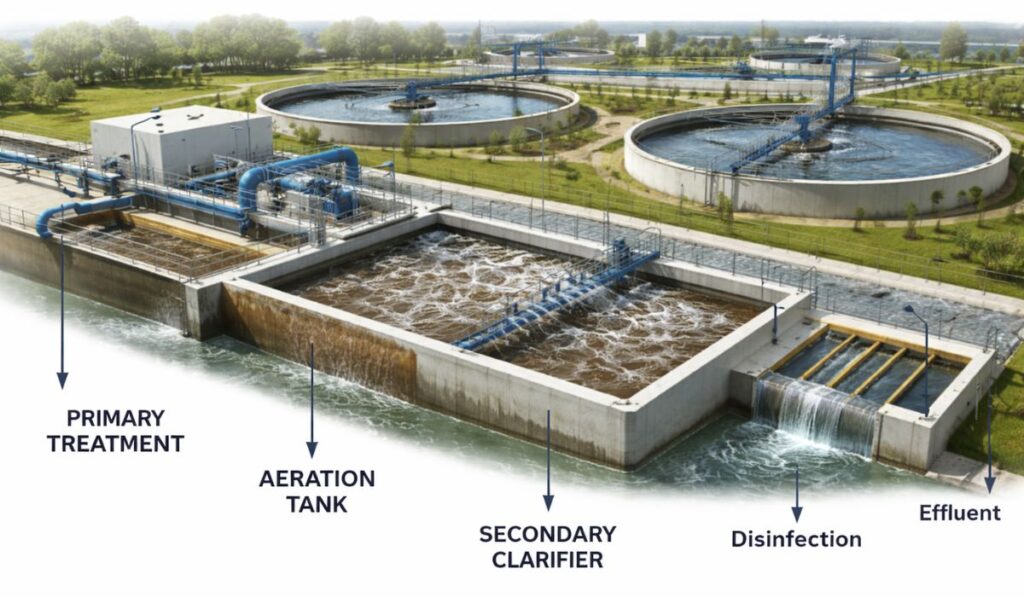
STP and ETP systems serve different purposes and cannot be used interchangeably. Facilities must evaluate wastewater sources and characteristics carefully before selecting a treatment solution. Proper system selection and engineering design ensure reliable operation and effective wastewater management.
FAQs – STP vs ETP
Q. What is the main difference between STP & ETP systems?
STP systems treat domestic sewage from residential and commercial facilities, while engineers design ETP systems to treat industrial effluent with complex chemical characteristics.
Q. Can STP and ETP be combined in one system?
In most cases, facilities treat domestic sewage and industrial effluent separately because their wastewater characteristics and treatment requirements differ significantly.
Q. Why does system design matter more than system type?
Treatment performance depends on how well the system is designed for actual wastewater conditions, flow variation, and operational stability rather than just the system category.
Author: Weltreat Systems – Water & Wastewater Engineering Team