
-
Email us at:
info@weltreatsystems.com -
Call us on:
020 - 41228334 - Download Brochure
28
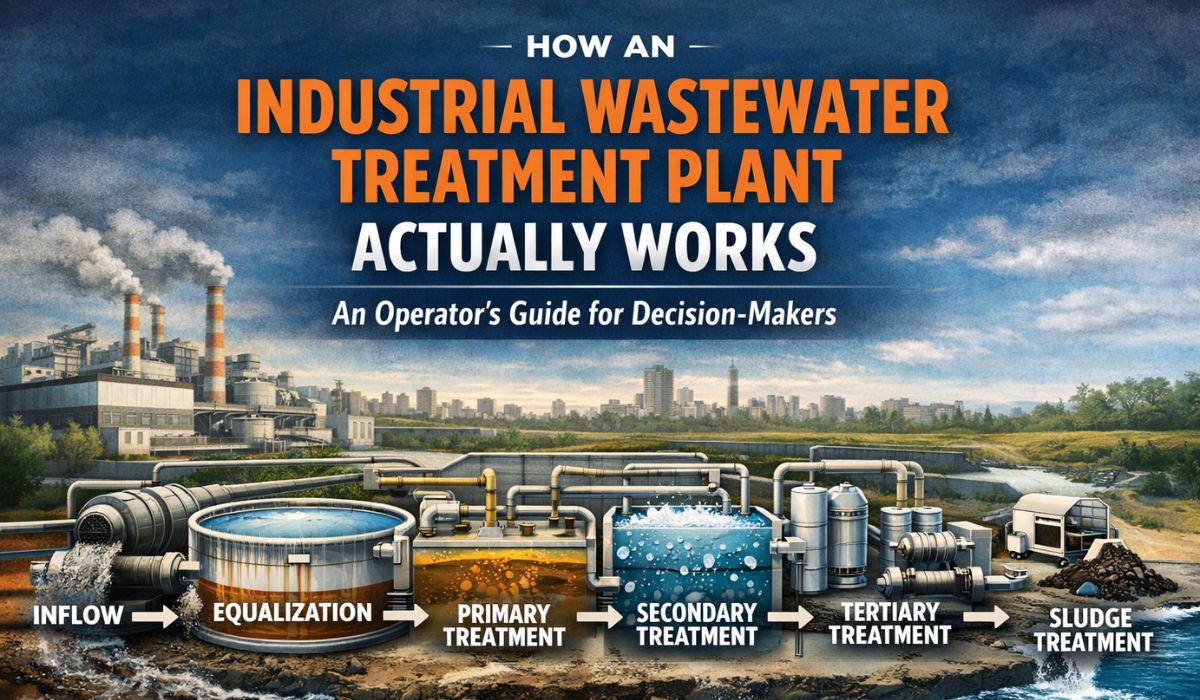
Jan 26How an Industrial Wastewater Treatment Plant Actually Works: An Operator’s Guide for Decision-Makers
- January 28, 2026
For a plant head or operations manager, an industrial wastewater treatment plant (ETP) is not a compliance checkbox. It is a critical, continuous, and often unpredictable piece of operational infrastructure. It’s where production meets environmental liability, and where poor design directly impacts your bottom line. This isn’t about textbook theory; it’s about managing a complex chemical, biological, and physical process under real-world conditions—variable flows, shifting contaminants, and tightening regulatory pressure.
The core challenge is this: your wastewater is a direct reflection of your manufacturing process. Its treatment is a risk-management and cost-optimization problem. A well-engineered ETP mitigates compliance risk, recovers value, and controls operating expenditure (OPEX). A poorly designed one becomes a constant source of capital drain, shutdowns, and non-compliance penalties.
Why Industrial Wastewater is a Different Beast Entirely
Understanding this distinction is the first step to avoiding costly design failures. Municipal sewage treatment plant (STP) logic does not translate to industry.
- Variability: Domestic sewage is relatively consistent in flow and composition. Industrial effluent changes hourly with production schedules, batch dumps, cleaning cycles, and product changeovers. This variability can shock and crash biological systems not designed for it.
- Toxicity & Complexity: Your wastewater likely contains specific pollutants—heavy metals, complex organic compounds (like dyes or pharmaceuticals), cyanides, oils, and toxic solvents—that domestic sewage does not. These can be inhibitory or lethal to the microorganisms at the heart of biological treatment.
- Strength: Industrial effluent often has an exceptionally high chemical oxygen demand (COD), biological oxygen demand (BOD), and total dissolved solids (TDS). Treating this “strength” requires robust, often multi-stage, processes.
Applying a standard STP design to industrial wastewater is a guarantee of operational failure and non-compliance.
The Industrial Wastewater Treatment Process: A High-Level View
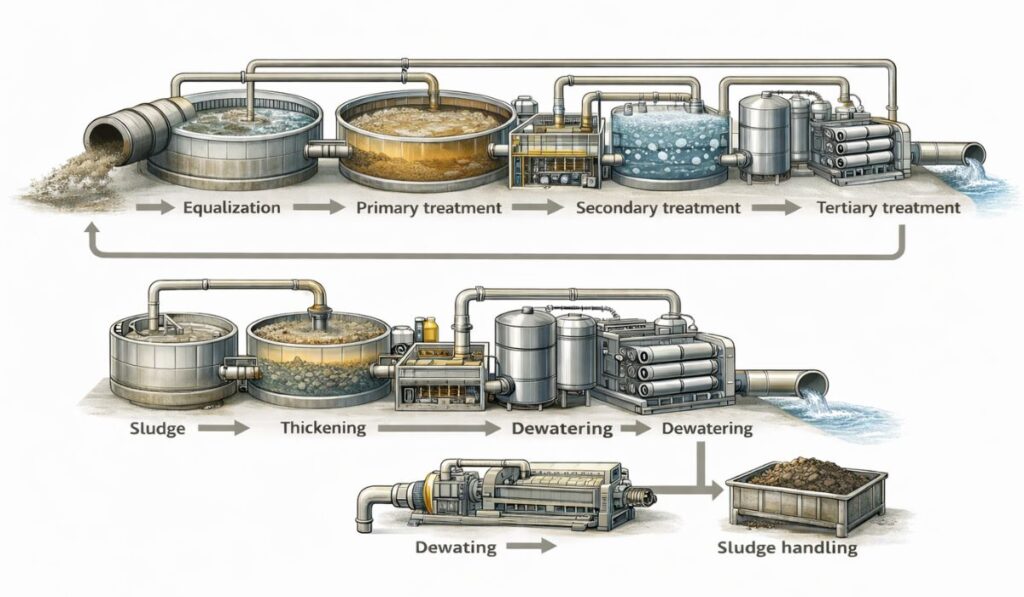
While designs are bespoke, the core engineering philosophy follows a cascading, defense-in-depth approach. The goal is to remove pollutants in stages: from large solids to dissolved ions.
- Pre-Treatment & Primary: Removal of physical contaminants (solids, oils, greases) and neutralization of extreme pH.
- Secondary (Core): Biological or chemical breakdown of the dissolved organic load—the main “pollution.”
- Tertiary (Polishing): Removal of specific remaining contaminants (color, nutrients, salts) to meet stringent discharge or reuse standards.
- Sludge Management: Handling the solid by-product generated at every stage—a major cost and compliance factor often underestimated.
There is no universal “one-size-fits-all” ETP design. A plant for a dairy will be fundamentally different from one for a metal plating unit or a pharmaceutical API manufacturer.
Step-by-Step: How an Industrial ETP Actually Works
1. Collection & Equalization: The Critical Buffer
This is the plant’s “shock absorber.” Wastewater from various process points flows into a collection sump and then into a large equalization tank. Here, variable streams are mixed to create a homogeneous, consistent flow in terms of volume, pH, temperature, and pollutant concentration. Operational Failure Point: Skipping or undersizing equalization passes production volatility directly into the treatment train, making precise chemical dosing and biological treatment impossible. It is the most cost-effective insurance you can buy.
2. Primary Treatment: Physical-Chemical Removal
Here, we remove everything that can be settled or floated.
- Screening & Oil/Grease Removal: Bar screens remove rags and debris. Dissolved air flotation (DAF) units or skimmers remove oils, grease, and suspended solids using chemical coagulants and fine air bubbles.
- Neutralization & Coagulation/Flocculation: Acids or alkalis are dosed to bring pH to a neutral range (6-9), which is essential for downstream processes and compliance. Further chemicals (coagulants like alum or ferric chloride, and flocculants) are added to clump together fine suspended particles into larger “flocs” that settle easily.
- Clarification/Sedimentation: In a primary clarifier, these flocs and other settleable solids settle by gravity. The settled material (primary sludge) is pumped for further handling, and the clarified overflow moves to secondary treatment.
3. Secondary Treatment: The Biological Engine
This is where dissolved organic pollutants (measured as BOD/COD) are biologically degraded. The system choice is paramount and depends on wastewater characteristics.
- Aerobic Systems (e.g., Activated Sludge Process – ASP): In an aeration tank, a consortium of microorganisms (activated sludge) is supplied with oxygen (via blowers and diffusers) to consume organic matter. The mixed liquor then flows to a secondary clarifier where microbes settle out as sludge, a portion of which is recycled to maintain the biomass. Suitability: High BOD waste (food, beverage, most biodegradable organics).
- Anaerobic Systems (e.g., UASB, Anaerobic Digesters): Microorganisms break down organics in the absence of oxygen, producing biogas (methane, which can be used as energy). Suitability: Extremely high-strength organic wastewater (distilleries, pulp & paper, some chemical). Often used before an aerobic system for energy recovery and OPEX reduction.
- Anoxic Systems: Used specifically for nutrient (Nitrogen) removal by creating conditions for denitrification.
Key Insight: “Poor biological selection” means forcing an anaerobic process on a low-strength stream (wasting capital) or using an aerobic process for highly toxic wastewater (killing the biomass). Biology must be matched to the wastewater fingerprint.
4. Tertiary Treatment: Polishing for Discharge or Reuse
Secondary effluent may still contain color, residual organics, nutrients (N, P), pathogens, and dissolved salts. Tertiary treatment is a toolkit of specialized processes:
- Filtration: Sand filters, activated carbon filters, or membrane filters (Ultrafiltration – UF) remove fine suspended solids and some organics.
- Advanced Oxidation Processes (AOP): Use powerful oxidants (e.g., ozone, UV/H2O2) to break down persistent, non-biodegradable organic molecules (common in pharma, chemical, and textile dye waste).
- Nutrient Removal: Specific biological or chemical steps to remove nitrogen and phosphorus to prevent algal blooms in receiving water bodies.
- Desalination/Softening: For reuse or Zero Liquid Discharge (ZLD), technologies like Reverse Osmosis (RO) remove dissolved salts.
5. Sludge Treatment & Disposal: The Hidden Cost Center
Sludge from primary and secondary clarifiers is 95-99% water. Managing it is 30-50% of a plant’s total operating cost.
- Thickening: Increasing solids content by gravity or flotation.
- Dewatering: Using centrifuges, filter presses, or drying beds to reduce volume, transforming sludge from a liquid to a semi-solid cake (20-40% solids). This drastically reduces disposal haulage costs.
- Stabilization/Digestion: Reducing pathogen content and organic matter, often through anaerobic digestion (which also produces biogas).
- Disposal: The final challenge. Options include incineration, co-processing in cement kilns, or secure landfill. Sludge disposal regulations in India are tightening; designing for minimal sludge generation and maximum dewatering is a direct OPEX saving.
Industry-Specific Wastewater Treatment Challenges
- Textile & Dyeing: High color, variable pH, and recalcitrant dyes. AOP is often essential. Salts from dyeing processes complicate reuse and ZLD.
- Pharmaceutical & Chemical: Complex, toxic, and sometimes inhibitory organic compounds. Requires rigorous equalization and often advanced pretreatment (like hydrolysis) before biological systems. Batch dumps are a major concern.
- Food & Beverage: High biodegradable organic load, but also fats, oils, and grease (FOG). Anaerobic pretreatment for biogas recovery is highly economical. Seasonality affects flow and load.
- Engineering & Metal Processing: Heavy metals (Cr, Ni, Zn, Cd), cyanides, and cutting oils. Treatment involves specific chemical precipitation, oxidation (for cyanide destruction), and meticulous pH control.
Common ETP Design and Operational Failures
- CAPEX vs. OPEX Myopia: Choosing the cheapest capital bid often leads to high chemical consumption, energy-guzzling equipment, and excessive sludge generation—locking in high OPEX for the plant’s lifetime.
- Ignoring Sludge Economics: Under-sizing dewatering equipment or not planning for disposal leads to a daily operational headache and spiraling costs.
- Overdesigned ZLD Systems: ZLD is energy-intensive and expensive. Installing it when not mandated by law or water scarcity is a severe financial misstep.
- Poor Automation & Monitoring: Relying on manual control leads to chemical overdosing, energy waste, and effluent quality spikes. Basic PLC/SCADA for pH, DO, and flow is now a necessity, not a luxury.
Compliance, Discharge Norms, and the On-Ground Reality
Indian regulations (CPCB, State PCB) set industry-specific discharge standards for parameters like pH, COD, BOD, TSS, and specific pollutants (metals, phenols, etc.). The reality is that norms are tightening, and enforcement is increasing. A compliant ETP today may be non-compliant in 3 years. Smart design builds in a 20-30% buffer for future norms and allows for modular expansion.
True sustainability goes beyond compliance. Water reuse within the plant reduces freshwater intake and trade effluent volume, offering a direct payback.
When Does an Industry Actually Need Zero Liquid Discharge (ZLD)?
ZLD is a philosophy of recovering all water and leaving behind only solid salts. It is not a default choice.
You need ZLD when:
- Located in a water-scarce region and reuse is an economic necessity.
- Discharge standards for TDS or specific ions are impossible to meet with conventional treatment.
- Operating in a zero-discharge zone mandated by regulators.
- Your process allows for the recovered salts to be of commercial value.
ZLD is likely unnecessary if you have access to a functional common effluent treatment plant (CETP) or can meet surface discharge standards with tertiary treatment. The capital and operational intensity of ZLD must be justified by water economics or regulation.
How Proper ETP Design Reduces Long-Term Operating Cost
A front-end engineering focus on OPEX yields a plant that is cheaper to run for decades.
- Energy: Selecting efficient blowers (for aerobic systems), employing anaerobic pre-treatment for biogas energy recovery, and using high-efficiency pumps and motors.
- Chemicals: Automated dosing tied to real-time sensors prevents waste. Choosing the right coagulant can reduce sludge volume by 20%.
- Sludge: Designs that minimize sludge production (e.g., extended aeration) and maximize dewatering efficiency directly cut disposal costs.
- Automation: Reduces manpower dependency and optimizes consumption of power and chemicals, ensuring consistent performance.
Key Factors to Evaluate Before Installing an Industrial ETP
- Wastewater Characterization: Not a one-time test. Conduct a multi-week, multi-shift profiling campaign to capture all variability. This data is the foundation of all design.
- Scalability & Flexibility: Can the system handle a 25% increase in production? Can it adapt to new products or pollutants?
- OPEX Clarity: Demand a detailed 10-year OPEX projection from your vendor, including chemicals, energy, sludge disposal, and maintenance.
- Vendor Capability: Choose a partner with experience in your industry, not just generic ETPs. They must understand your process to treat its waste.
- Lifecycle View: View the ETP as a 15-year asset. The lowest lifecycle cost (CAPEX + OPEX) is the true metric, not the lowest bid.
Conclusion

An industrial wastewater treatment plant is a live, engineered system—a critical extension of your production line. Its success is measured not just in compliance certificates, but in predictable operating costs, resilience to process changes, and contribution to resource security. The decision to install or upgrade an ETP is a strategic one. It demands moving beyond equipment procurement to a holistic understanding of your wastewater’s fingerprint, the regulatory trajectory, and the total cost of ownership. The right design, focused on your specific context, transforms wastewater treatment from a liability into an area of managed risk and even operational advantage.
Need a second opinion on your existing ETP’s performance or planned expansion? Sometimes, an independent review of design, operational data, and cost structure can identify immediate optimization opportunities. We advise on the engineering, not the equipment sale.